TL;DR

Get business pricing on tools and workshop supplies
- Business-only prices and quantity discounts
- Tax-exempt purchasing
- Multiple users, one account, clear invoices
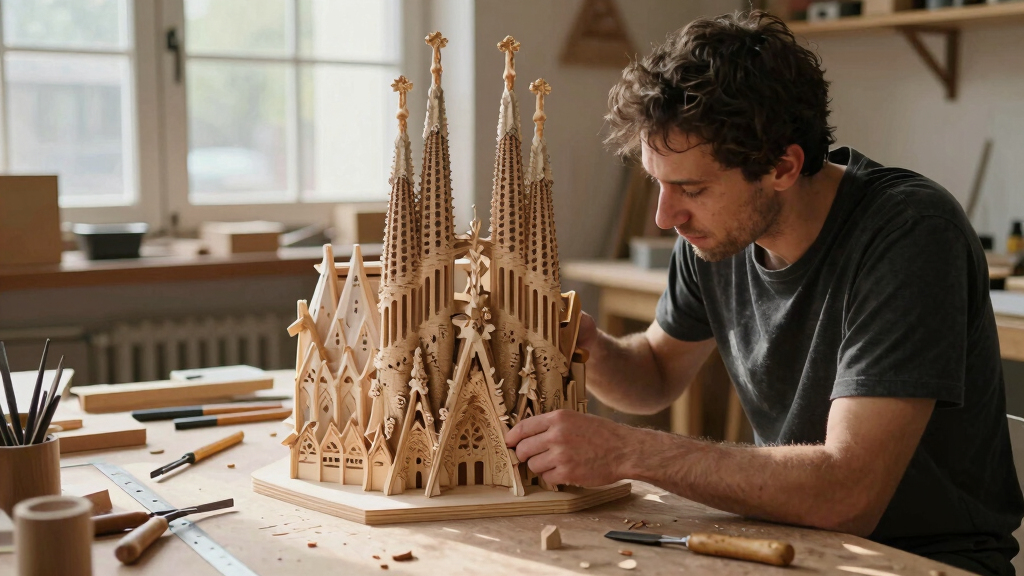
Researchers have uncovered new mathematical principles embedded in the design of Barcelona’s Sagrada Familia, shedding light on Gaudí’s innovative use of geometry. This discovery enhances understanding of the basilica’s architectural complexity and may influence future architectural design.
Researchers have identified complex mathematical principles embedded in the design of Barcelona’s Sagrada Familia, revealing Gaudí’s innovative use of geometry and structural mathematics. This discovery offers new insights into one of the world’s most iconic architectural masterpieces and highlights the depth of Gaudí’s technical ingenuity.
Recent academic studies, published in late 2023, have analyzed the geometric and mathematical patterns within the Sagrada Familia, confirming that Gaudí employed advanced mathematical concepts, including fractal geometry and hyperbolic paraboloids, in its design. These principles contributed to the basilica’s structural stability and aesthetic harmony.
Researchers from the University of Barcelona and other institutions used computer modeling and mathematical analysis to uncover these hidden patterns. The findings suggest that Gaudí’s work was not only artistic but also deeply mathematical, reflecting a sophisticated understanding of geometry and structural physics.
While the precise mathematical formulas and their full application in the basilica’s construction are still being studied, the discovery confirms that Gaudí’s architectural vision was rooted in complex mathematical thinking, which has remained largely unrecognized until now.
Why Uncovering These Mathematical Principles Matters for Architecture
This discovery enhances appreciation for Gaudí’s technical mastery and demonstrates how mathematics can be integral to innovative architecture. It may influence modern architectural design by encouraging the integration of complex mathematical models for structural efficiency and aesthetic appeal.
The findings also deepen cultural understanding of the basilica as a fusion of art and science, highlighting Gaudí’s role as both an artist and a mathematician. Such insights could inspire new approaches in architectural education and preservation efforts.
geometric design tools for architects
As an affiliate, we earn on qualifying purchases.
As an affiliate, we earn on qualifying purchases.
Historical and Architectural Context of Gaudí’s Mathematical Approach
Antoni Gaudí began work on the Sagrada Familia in 1882, and it remains unfinished today. Known for his organic and highly detailed style, Gaudí incorporated innovative engineering techniques and geometric forms, such as hyperboloids and helicoids, to achieve both aesthetic and structural goals. Despite extensive study, the full extent of his mathematical methods has remained largely speculative until now.
Previous research has recognized Gaudí’s use of natural forms and geometry, but recent breakthroughs in computational analysis have allowed scientists to identify specific mathematical patterns embedded in his designs, confirming that his work was guided by complex mathematical principles.
This aligns with Gaudí’s known fascination with nature’s geometries and his belief that mathematics could reveal the divine order of the universe, which he sought to reflect in his architecture.
“These discoveries deepen our understanding of Gaudí as both an artist and a mathematician, highlighting the scientific precision behind his visionary design.”
— Professor Juan Martinez, architectural historian
Remaining Questions About the Mathematical Foundations
While researchers have identified key mathematical patterns, the exact formulas Gaudí used and how they were applied during construction remain partially unclear. The full extent of his mathematical methodology is still being explored, and some details of how these principles influenced specific structural decisions are not yet confirmed.
Further research is needed to determine whether Gaudí developed new mathematical techniques or adapted existing ones, and how these influenced the ongoing construction process.
Future Research and Potential Architectural Innovations
Scientists plan to continue analyzing Gaudí’s mathematical models using more advanced computational tools, aiming to reconstruct detailed formulas and understand their application during construction. This could lead to new insights into Gaudí’s engineering methods, potentially influencing modern architectural design.
Additionally, researchers hope that these findings will be integrated into preservation efforts, ensuring that the basilica’s unique structural and aesthetic qualities are maintained for future generations.
Key Questions
What specific mathematical principles did Gaudí use in the Sagrada Familia?
Researchers have identified patterns such as fractal geometry, hyperboloids, and hyperbolic paraboloids in Gaudí’s design, but the full mathematical formulas are still under study.
How does this discovery change our understanding of Gaudí’s work?
It reveals that Gaudí’s architecture was deeply rooted in complex mathematical principles, demonstrating a scientific dimension to his artistic vision that was previously underappreciated.
Will this affect future construction or restoration of the basilica?
Potentially, yes. Understanding Gaudí’s mathematical models could inform more precise restoration techniques and inspire new architectural innovations based on his methods.
Are these mathematical principles unique to Gaudí?
While Gaudí’s use of advanced geometry was exceptional, many architects and engineers use mathematical models today. His integration of these principles was notably sophisticated for his time.
When will further details of these mathematical discoveries be published?
Researchers plan to publish more detailed findings in upcoming academic journals over the next year, as they continue analyzing the basilica’s design.
Source: hn
Columbus Day / Indigenous Peoples' Day Picks
long weekend sales
As an affiliate, we earn on qualifying purchases.