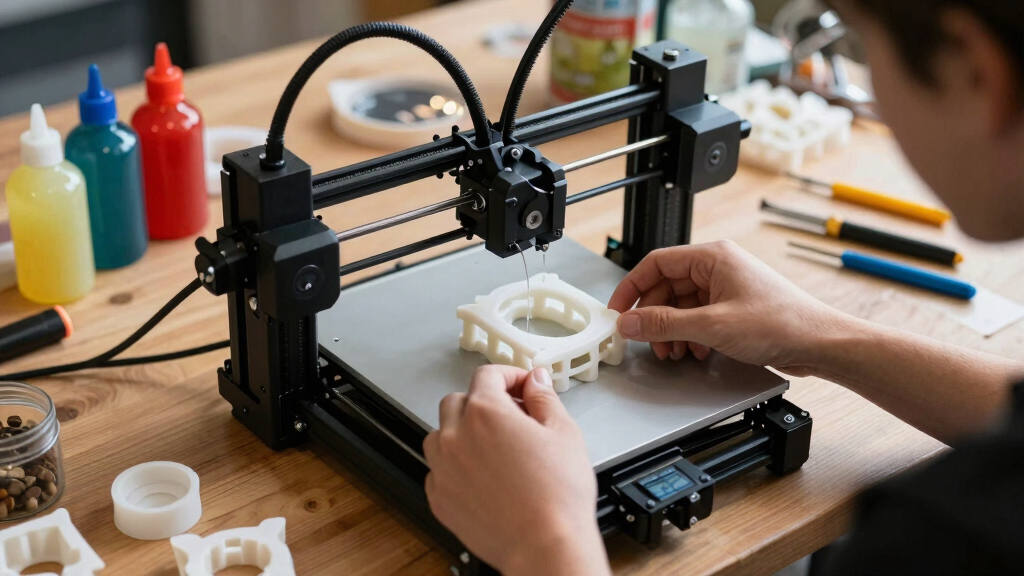
When searching for the best 3D printer for molds and jigs, precision, build volume, and reliability are key. The FLASHFORGE AD5M stands out for its high speed and auto-leveling, making it ideal for detailed mold work. The Creality Ender 3 offers a solid balance of affordability and quality, perfect for hobbyists. Meanwhile, the Entina TINA2S provides beginner-friendly features with decent precision. Choosing the right machine involves balancing speed, detail, ease of use, and budget. Continue reading to see how these options compare and find the best fit for your needs.
Key Takeaways
- High-speed printing capabilities are less critical for mold and jig production, where detail and accuracy matter more.
- Auto-leveling features significantly reduce setup time and improve consistency, especially for complex molds.
- Build volume should match the size of your typical molds and jigs, but larger isn’t always better if it complicates calibration.
- Ease of use and maintenance are vital for frequent production, favoring models with straightforward interfaces and reliable components.
- Price varies widely; investing in a slightly more expensive, durable machine can save money over time through fewer errors and repairs.




More Details on Our Top Picks
FLASHFORGE 3D Printer AD5M, CoreXY 600mm/s High-Speed Printer with 1-Click Auto Leveling, High-Temp Direct Drive Extruder, 3s Quick-Swap Nozzle, 220×220×220mm Build Volume
The FLASHFORGE AD5M stands out for its incredible high-speed capabilities, reaching up to 600mm/s, which makes it ideal for rapidly producing molds and jigs where time is critical. Its CoreXY structure ensures stability at these speeds, while the 1-Click auto-leveling simplifies setup, reducing downtime. Unlike the Ender 3, which requires manual leveling, this model offers more consistent first layers, especially when working with complex jigs. The high-temp direct drive extruder supports a range of materials, although it maxes out at 280°C, limiting some high-temperature filaments. The quick-swap nozzles (3 seconds) enhance flexibility for different layer resolutions, which is less convenient on less advanced models. The open-source firmware allows upgrades, but that may involve some technical learning. This printer is perfect for professionals or makers needing fast turnarounds, but it requires regular maintenance due to its high-speed operation.
Pros:- Incredible printing speeds up to 600mm/s for fast production
- Automatic bed leveling ensures consistent first layers
- Supports multiple nozzle sizes for versatile detail and efficiency
- Open-source firmware allows hardware and software upgrades
Cons:- Requires regular maintenance due to high-speed operation
- Limited to 280°C, restricting some high-temp materials
- Complex setup may require technical knowledge
Best for: Engineers and rapid prototyping shops needing quick turnaround on molds and jigs
Not ideal for: Beginners or hobbyists seeking a simple, plug-and-play solution without frequent maintenance
- Build Volume:220×220×220mm
- Max Speed:600mm/s
- Extruder Temperature:280°C
- Structure Type:CoreXY
- Nozzle Sizes:0.25–0.8mm
- Auto Leveling:Yes
Bottom line: This printer excels for high-volume, fast-turnaround mold and jig production, suitable for advanced users who can handle its upkeep.
FLASHFORGE Adventurer 5M 3D Printer with Fully Auto Leveling System, Max 600mm/s High-Speed, 280℃ Quick-Detach Nozzle, CoreXY Structure for Superior Print Quality, Rookies & Experts Smart Choice
The Adventurer 5M makes a strong case as the best choice for both beginners and experienced users looking for reliable, high-quality prints. Its fully automatic leveling system removes the hassle of manual calibration, unlike the Ender 3, which demands more setup time. The CoreXY structure supports impressive speeds up to 600mm/s, comparable to the AD5M, yet it’s more approachable for new users thanks to its simplified interface and built-in features. The quick-detachable nozzle (in 3 seconds) offers easy maintenance and switching between different diameters, similar to the AD5M but with a more user-friendly experience. Its remote management via app allows monitoring and adjusting from anywhere, which is less straightforward on less advanced models. While it supports high-temp materials, its 280°C limit still restricts some specialty filaments. This pick suits hobbyists and educational settings, especially those new to 3D printing but wanting high performance.
Pros:- Fully automatic bed leveling for easy setup
- High printing speeds up to 600mm/s with stable CoreXY design
- Quick-change nozzle system reduces maintenance time
- Supports remote monitoring via mobile app
Cons:- Limited to 280°C, restricting some high-temp filament use
- Relatively higher price point for entry-level users
- Requires regular cleaning and maintenance for optimal performance
Best for: Beginners, educators, and hobbyists seeking effortless setup with professional results
Not ideal for: Advanced users requiring higher temperature materials or ultra-fast production speeds
- Build Size:220×220×220mm
- Max Speed:600mm/s
- Extruder Temp:280°C
- Auto Leveling:Yes
- Connectivity:WiFi & App control
- Nozzle Sizes:0.25/0.4/0.6/0.8mm
Bottom line: This printer provides a perfect balance of ease of use and high-quality output for those new to 3D printing or in educational environments.
Entina TINA2S 3D Printers with WiFi Cloud Printing, Fully Assembled with Auto Leveling, Huge Library, DIY Mini 3D Printer for Beginners and Kids, High Precision 3D Printer for Home, Office & School
The Entina TINA2S is designed specifically for newcomers and educational environments, offering WiFi cloud printing and fully assembled convenience. Unlike the larger, more complex models like the Flashforge AD5M, the TINA2S is compact and ready to run, making it ideal for classrooms and home use. Its auto leveling system minimizes setup time, and the library of 1,000+ models helps beginners start printing quickly, though it’s less suited for detailed mold work that requires larger build volumes. The print resolution of 0.04mm ensures decent quality for small projects, but it’s not optimized for high-detail molds or jigs. Its limited build size (3.9 x 4.7 x 3.9 inches) makes it less ideal for larger jigs but perfect for small, quick prototypes. The low noise and simple interface make this a good choice for educational or family environments, but it’s less capable for professional mold production.
Pros:- Fully assembled and ready to use out of the box
- WiFi cloud printing for easy file transfer
- Auto leveling reduces setup complexity
- Quiet operation suitable for classrooms or home use
Cons:- Limited build volume not suitable for larger molds or jigs
- Maximum print size is small for serious mold work
- Supports only up to 0.04mm resolution, less ideal for high-detail prototypes
Best for: Beginners, students, and educators needing a compact, easy-to-use printer with WiFi features
Not ideal for: Professionals requiring large build volumes or high-temp filament compatibility
- Build Volume:3.9×4.7×3.9 inches
- Print Resolution:0.04mm
- Connectivity:WiFi & App
- Auto Leveling:Yes
- Printer Type:Mini FDM
- Supported Models:1000+
Bottom line: A perfect compact choice for beginners and educational settings, though not suited for large or high-precision mold projects.
FLASHFORGE Adventurer 5M 3D Printer with Fully Auto Leveling and High-Speed Printing
The FLASHFORGE Adventurer 5M is tailored for users who prioritize speed and ease of use, with its automatic bed leveling and high-speed printing up to 600mm/s. Its compact size and quick warm-up time (35 seconds to 200°C) make it ideal for fast-turnaround mold and jig fabrication. Unlike the Ender 3, which requires manual setup, the 5M’s auto leveling and plug-and-play operation streamline workflow, especially for busy professionals. The dual-fan nozzles and vibration compensation support high-quality surface finishes, though it is limited to a 280°C extruder temperature, restricting some high-temp materials. The included remote control via mobile app makes it convenient for remote monitoring, a feature less developed in traditional printers. While it excels in speed, regular maintenance like nozzle cleaning is necessary, and it may require troubleshooting for advanced features.
Pros:- High-speed printing up to 600mm/s for rapid prototyping
- Automatic bed leveling for quick setup
- Fast warm-up and responsive operation
- Remote monitoring via mobile app
Cons:- Limited to 280°C, restricting some filament choices
- Requires regular maintenance for optimal results
- Slightly complex troubleshooting for advanced features
Best for: Designers and prototyping teams needing quick, reliable, high-speed printing
Not ideal for: Users who need to print with high-temperature materials or require ultra-fine details
- Build Size:220×220×220mm
- Max Speed:600mm/s
- Extruder Temp:280°C
- Auto Leveling:Yes
- Connectivity:Mobile App & USB
- Nozzle Sizes:0.25–0.8mm
Bottom line: This printer is excellent for fast-paced environments where speed and ease of use outweigh ultra-high temperature capabilities.
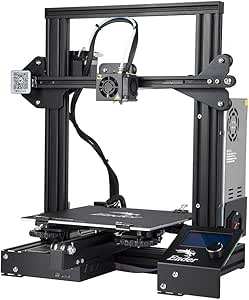
Creality Ender 3 3D Printer with Resume Printing Function (Build Volume: 8.66×8.66×9.84 inch)
The Ender 3 remains a popular choice for those starting in mold and jig printing on a budget. Its resume printing feature provides peace of mind during power outages, and the manual assembly process, taking around 2 hours, offers a hands-on introduction to 3D printer mechanics. Unlike the Flashforge models, it doesn’t have auto leveling, requiring users to calibrate manually, which can be a learning curve but also offers greater control. The upgraded extruder reduces clogging and enhances reliability, although high-speed printing at 8.66×8.66×9.84 inches can sometimes compromise detail. The open-frame design facilitates easy access but exposes the print to environmental factors, unlike enclosed printers. It’s best for hobbyists who want a straightforward, expandable machine with longer-term upgrade potential but are comfortable with some setup and troubleshooting.
Pros:- Resume printing after power loss for reliability
- Affordable entry point with upgrade options
- Good build volume for small to medium molds
- Open design simplifies maintenance and filament changes
Cons:- No auto bed leveling; manual calibration needed
- Requires assembly and troubleshooting skills
- Limited high-temp filament support
Best for: Hobbyists and students seeking a cost-effective, DIY-friendly printer for mold and jig prototyping
Not ideal for: Users needing high-temperature filament support or fully automated operation
- Build Volume:8.66×8.66×9.84 inches
- Resume Function:Yes
- Assembly:Approx. 2 hours
- Extruder Type:Upgraded
- Supported Filaments:PLA, ABS, PETG (limited high-temp)
- Frame:Open
Bottom line: A solid, budget-friendly choice for hobbyists willing to handle some setup and calibration for mold and jig production.
Official Creality Ender 3 3D Printer with Resume Printing, Stable Power Supply, Precise Printing, and V-Slot Rails, DIY 3D Printer, Printing Size 8.66×8.66×9.84 inches, Ideal for Mold Sample Printing
This version of the Ender 3 excels in combining reliable, high-quality prints with a generous build volume, making it an excellent choice for mold and jig creation. Its precision nozzle and ±0.1mm accuracy ensure detailed prototypes, comparable to higher-end options but at a much more accessible price. The large 220 x 220 x 250 mm bed accommodates medium-sized molds comfortably, while the rapid-heating heated bed reduces warping for consistent results. The resume printing feature adds security against power failures during critical print jobs. Compared to the AOSEED, which is geared toward beginners and kids, this model offers a more stable platform for production-quality molds, though it lacks the AI-driven automation and speed of the AOSEED. Its main tradeoff is that assembly and calibration require some effort, and it’s less suited for ultra-high-speed production. Overall, this pick is ideal for makers needing dependable, precise results without the complexity of advanced automation.
Pros:- High-resolution accuracy up to ±0.1mm for detailed mold samples
- Large build volume suitable for medium-sized prototypes
- Fast heat-up of the heated bed minimizes downtime
- Resumes printing after power interruptions
Cons:- Requires assembly and calibration, which can be time-consuming
- Lacks automated features found in more advanced models like AOSEED
Best for: Experienced hobbyists or small-scale moldmakers who want a reliable, precise printer with a large build volume at a reasonable price.
Not ideal for: Complete beginners seeking an ultra-simple setup, or those needing rapid production speeds for high-volume work.
- Build volume:220 x 220 x 250 mm
- Nozzle precision:±0.1mm
- Heated bed temperature:Up to 110°C
- Print accuracy:High
- Power supply:Stable, reliable
- Extruder technology:Upgraded extruder
- Connectivity:SD card, USB
- Weight:15.4 pounds
Bottom line: This Ender 3 is best suited for users who need dependable, detailed mold and jig prototypes without the complexity of high-speed automation.
AOSEED 3D Printer for Kids, AI-Powered Fully Assembled 3D Printer with Up to 400mm/s Speed, Auto Leveling, 1500+ Models & 16+ Modules, Includes 8 PLA Filaments for Home and School Use, X-MAKER JOY AI+
The AOSEED X-MAKER JOY AI+ stands out for its ease of use, rapid speed, and extensive creative library, making it perfect for young makers and educational settings. Its AI-powered design allows kids to create models via voice, text, or images—no design experience needed—while the auto-leveling platform simplifies setup. Its impressive peak speeds of 400 mm/s and 0.05mm precision allow for quick, detailed projects that suit quick prototyping or creative exploration. Unlike the Ender 3, which emphasizes precision and larger build volume, this model prioritizes speed and simplicity, though it sacrifices some of the fine detail and larger size needed for complex mold samples. Its built-in camera and real-time monitoring make it ideal for families and classrooms, but it’s less suitable for serious mold-makers who require high-resolution, large-volume prints. This printer is a playful, highly accessible choice for fostering creativity among children and beginners.
Pros:- AI-driven model creation via voice, text, or images
- Auto-leveling platform for quick, hassle-free setup
- Rapid printing speeds up to 400 mm/s
- Includes a large digital model library and DIY customization options
Cons:- Limited build volume not suitable for large molds
- Lower resolution compared to industrial-grade models
- Designed primarily for beginners and kids, not professional use
Best for: Parents, teachers, and young hobbyists seeking a safe, fast, and easy-to-use 3D printer with extensive creative options.
Not ideal for: Professional mold makers or users needing large build sizes and ultra-high resolution for detailed prototypes.
- Peak speed:up to 400 mm/s
- Precision:0.05 mm
- Build volume:150 x 150 x 150 mm
- Connectivity:Wi-Fi, app control
- Material compatibility:PLA, others
- Auto-leveling:Yes
- Included filaments:8 rolls of PLA
- Speed modes:up to 400 mm/s
Bottom line: This AOSEED model makes the most sense for families and educational environments where ease of use, speed, and creativity are priorities over large or ultra-fine molds.
How We Picked
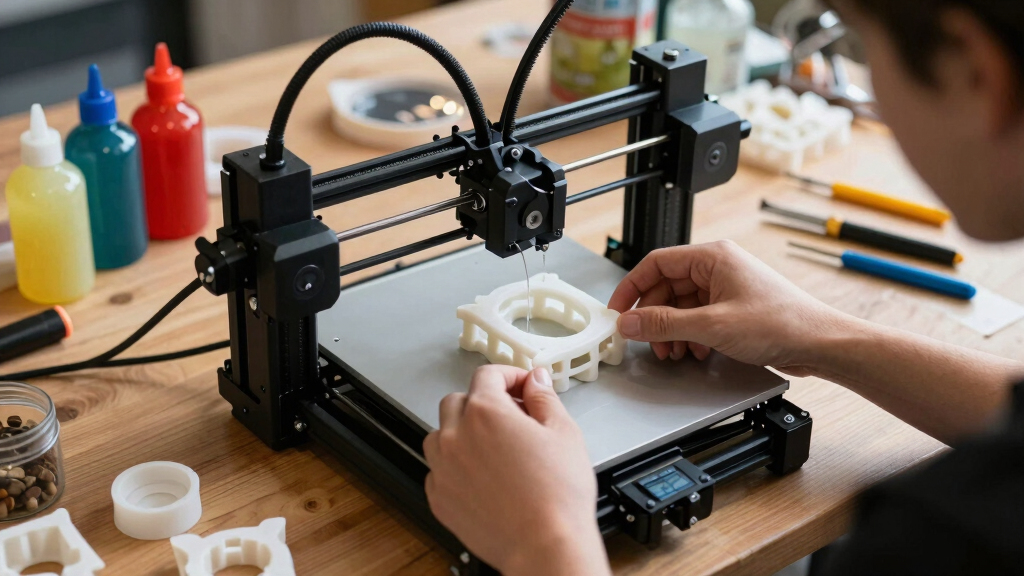
These printers were selected based on their suitability for producing high-precision molds and jigs, considering factors like print quality, accuracy, build volume, reliability, and user experience. We prioritized models with features that benefit mold and jig creation, such as auto-leveling, stable extrusion, and ease of maintenance. Additional considerations included overall value, speed, and versatility for different skill levels. The ranking reflects a balance between professional-grade performance and beginner-friendly features, ensuring options for various budgets and expertise levels.Factors to Consider When Choosing Best 3d Printer For Molds And Jigs
Choosing the best 3D printer for molds and jigs involves evaluating several key factors. While price is important, the focus should be on precision, reliability, and ease of use. A machine that offers consistent, detailed prints minimizes post-processing and helps achieve accurate molds. Build volume should align with the typical size of your projects, but larger models can add complexity. Maintenance and support also influence long-term satisfaction. Keep these considerations in mind to select a printer that balances performance with your specific needs.Print Quality and Precision
Producing effective molds and jigs demands high detail and accuracy. Look for printers with a reputation for fine layer resolution and stable extrusion. Features like direct drive extruders and precise stepper motors contribute to cleaner detail and smoother surfaces. Keep in mind that a higher resolution setting may slow down your print; balance quality with speed based on your project needs.
Build Volume
The size of your molds or jigs determines the necessary build volume. A larger volume allows for bigger projects without splitting, but it often comes with increased calibration challenges and longer print times. If your work typically involves small to medium-sized parts, a mid-sized build area offers a good compromise. Always measure your typical projects before committing to a machine.
Ease of Use and Reliability
For consistent results, choose a printer with auto-leveling and user-friendly interfaces. Reliable components reduce downtime and frustration, especially in a production setting. Consider models with sturdy frames, proven track records, and accessible support. Remember that ease of maintenance can save significant time and costs over the machine’s lifespan.
Speed and Workflow Efficiency
While high speed isn’t the main concern for molds and jigs, efficient workflows matter. Features like quick-change nozzles, fast heating, and optimized slicing software can speed up production without sacrificing detail. Balance speed with quality—rushing can lead to errors that compromise mold accuracy.
Budget and Long-Term Value
Budget constraints influence your choice, but investing in a durable, high-quality machine often pays off through fewer repairs and better results. Consider future-proof features like upgradeability or compatibility with different materials. Sometimes, spending a bit more upfront results in better precision and reliability, especially for professional or repeated use.
Frequently Asked Questions
What’s the most important feature for printing molds and jigs?
For molds and jigs, the most critical feature is high print resolution combined with reliable extrusion. This ensures that detailed features are accurately reproduced, which is essential for creating effective molds. Auto-leveling and stable frames further support consistent quality, reducing the need for extensive post-processing.
Should I prioritize a larger build volume for mold printing?
A larger build volume can be advantageous if you frequently work on big molds or multiple small parts simultaneously. However, larger machines can be more complex to calibrate and maintain. If your projects are typically small to medium-sized, a mid-sized build volume often offers the best balance between usability and capacity.
Is auto-leveling necessary for precision mold work?
Auto-leveling significantly improves the consistency of your prints, especially for intricate molds. It reduces manual effort and minimizes errors caused by uneven beds, leading to more precise and reliable results. For frequent or professional mold production, auto-leveling is a worthwhile feature to ensure quality and efficiency.
How important is material compatibility for molds and jigs?
Material compatibility is vital because different molds may require specific plastics, resins, or composites. Check that the printer supports the materials you plan to use, including high-temp filaments if your molds need heat resistance. This flexibility can extend the machine’s usefulness and prevent costly upgrades later.
Should I buy a beginner-friendly or professional-grade printer?
If you’re new to 3D printing or only need to produce occasional molds, a beginner-friendly model with auto-leveling and straightforward controls makes sense. For ongoing, high-precision work, investing in a more advanced, professional-grade machine offers better accuracy, stability, and long-term reliability, which can save time and money over repeated use.
Conclusion
For users focused on professional mold-making or high-precision jig production, the FLASHFORGE AD5M stands out as the best overall choice thanks to its speed and accuracy. Hobbyists or small-scale producers will find the Creality Ender 3 offers excellent value and reliability. Beginners or educational settings benefit from the Entina TINA2S with its simple setup and decent detail. For those seeking premium features, the FLASHFORGE Adventurer 5M delivers advanced automation and high-speed capabilities. Finally, budget-conscious buyers aiming for versatility might consider the AOSEED 3D Printer for Kids or similar models, which balance affordability with core functionality.