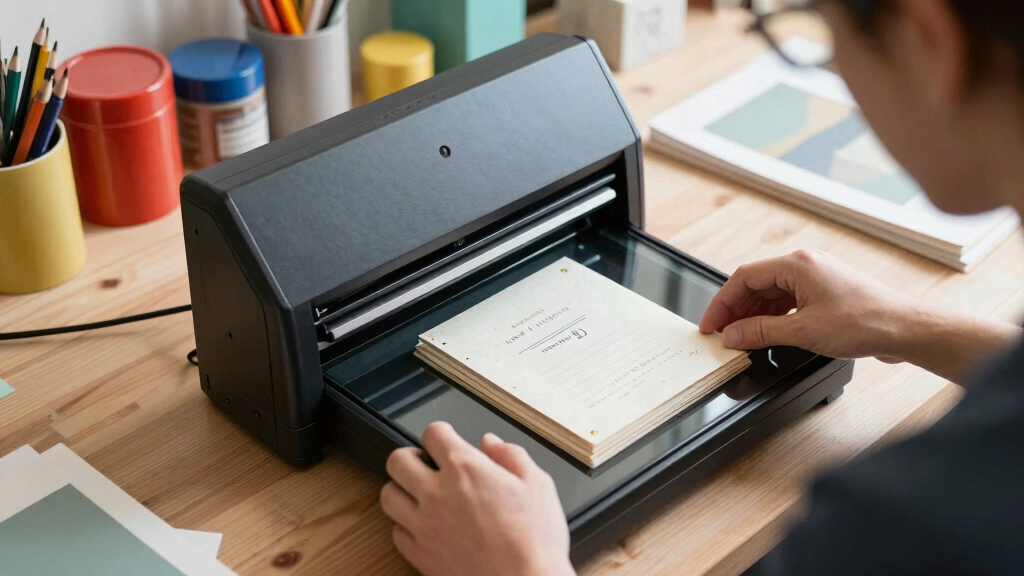

Finding the best overhead book scanners for journals and letters involves balancing high-resolution imaging, ease of use, and versatility. The ScanSnap SV600 stands out as the overall top pick due to its reliable performance and straightforward setup. For those needing portability, the CZUR Shine Ultra offers impressive OCR features in a compact form. Meanwhile, large-format needs are best served by options like the A2 Overhead Scanner. Each choice involves tradeoffs between image quality, size, and price, so continue reading for a detailed breakdown of the top models and what makes them suitable for your specific needs.
Key Takeaways
- High-resolution sensors like 38MP and 23MP are essential for capturing fine details in journals and letters.
- Portability varies widely; some scanners are compact and foldable, ideal for mobile use, while others are large but offer better imaging capabilities.
- Auto-flattening and curve correction significantly improve scan quality, especially for bound materials.
- Built-in OCR and multi-language support are critical for digitizing handwritten or diverse language documents.
- Tradeoffs often exist between price and advanced features; premium models tend to offer better image processing but at a higher cost.
| ScanSnap SV600 Overhead Book and Document Scanner |  | Best Overall for Versatile Book and Document Scanning | Color: Black | Type: Overhead Document Scanner | VIEW LATEST PRICE | See Our Full Breakdown | |
| CZUR Shine Ultra Smart Portable Document Scanner with OCR for Windows & Mac |  | Best for Speed and Portability in Digital Capture | Resolution: 245 DPI (A3), 340 DPI (A4) | Paper Size: A3, A4 | Compatibility: Windows XP/11, macOS 10.13+ | VIEW LATEST PRICE | See Our Full Breakdown |
| A2 Overhead Scanner for Large Format Documents and Books |  | Best for Large-Format and High-Resolution Scanning | ASIN: B0F29BL9KW | Resolution: 23MP | Lighting Control: 3-level LED adjustable brightness | VIEW LATEST PRICE | See Our Full Breakdown |
| CZUR Aura Pro Portable Book Scanner, A3 Document Scanner with Auto-Flatten & Fingerprint Removal |  | Best for Portable, Fast, and Curved Book Scanning | Scanner Type: Document Scanner | Resolution: 1300 dpi | Paper Size: Up to A3 | VIEW LATEST PRICE | See Our Full Breakdown |
| NetumScan 13MP Foldable Document Camera with AI OCR and Real-Time Projection |  | Best for Interactive and Multi-Function Use | Sensor: 13MP CMOS | Capture Size: A4 | Lighting Feature: Stepless dimming LED | VIEW LATEST PRICE | See Our Full Breakdown |
| CZUR ET MAX Book Scanner, 38MP High-Resolution Overhead Document Scanner with Curve-Flattening, Auto Page Detection, OCR, HDMI Output, Compatible with Windows/Mac/Linux |  | Best Overall for Professional and Heavy-Duty Use | Resolution: 38MP (410 DPI) | Scan Size: A4 (standard for books) | Compatibility: Windows, macOS, Linux | VIEW LATEST PRICE | See Our Full Breakdown |
| JOYUSING 14MP HD Document Scanner with A3 Scanning and Multi-Language OCR |  | Best for Portable, On-the-Go Scanning of Larger Documents | Resolution: 14MP | Scan Size: A3 | Speed: < 3 seconds/page | VIEW LATEST PRICE | See Our Full Breakdown |
| A2 Overhead Scanner for Large Format Documents and Books with 23MP Resolution |  | Best for Large-Format Documents and Maps | Resolution: 23MP (5504×4128 pixels) | Scan Size: A2 | Compatibility: Windows 7/8/10, macOS | VIEW LATEST PRICE | See Our Full Breakdown |
| NetumScan 13MP Foldable Document Camera with OCR for Teachers |  | Best for Classroom and Online Teaching | Megapixels: 13MP | Sensor Type: CMOS 1300W | Capture Size: A3/A4 | VIEW LATEST PRICE | See Our Full Breakdown |
More Details on Our Top Picks
ScanSnap SV600 Overhead Book and Document Scanner
The ScanSnap SV600 stands out for its ability to scan fragile books and documents without causing damage, thanks to its overhead design and gentle page detection. Unlike the CZUR ET MAX, which offers higher resolution but requires more setup, the SV600 simplifies batch scanning with multi-document detection and auto book correction, making it ideal for archival projects. However, its larger footprint demands a dedicated space, and it lacks built-in organization features, so it’s less suited for those needing quick, on-the-fly digitization in small workspaces. This model is best for libraries, archivists, or researchers handling delicate materials that need careful preservation without manual flattening or extensive post-processing.
Pros:- Scans fragile documents without damage
- Multi-document detection for efficient batch processing
- Auto book correction flattens curved pages
- Point retouch removes fingers from scans
Cons:- Larger footprint requires significant desk space
- No built-in file organization or storage features
Best for: Archivists and librarians needing gentle, high-quality digitization of fragile books and documents
Not ideal for: Small office users or students requiring a compact, multi-function device with integrated storage
- Color:Black
- Type:Overhead Document Scanner
Bottom line: This scanner suits users prioritizing gentle handling and high-quality scans of delicate materials over compact size or integrated filing.
CZUR Shine Ultra Smart Portable Document Scanner with OCR for Windows & Mac
The CZUR Shine Ultra excels in delivering lightning-fast scans—just one second per page—making it ideal for quick digitization of books, especially in a remote or mobile setting. Its lightweight, foldable design and adjustable stand make it more portable than larger overhead scanners like the SV600 or A2, but it sacrifices some resolution and advanced flattening features. Compared with the A2 overhead, which offers high resolution for large-format archives, the Shine is better suited for standard-sized books and documents where speed and convenience matter most. Users needing extensive editing or handling large, bulky volumes should consider alternative models, as this scanner is optimized for thin books and flat papers on Windows or Mac systems only.
Pros:- Ultra-fast scanning (1 second per page)
- Lightweight and portable for mobile use
- OCR supports 180+ languages
- Adjustable height and easy setup
Cons:- Limited to thinner books or documents, not for thick volumes
- Requires Windows or macOS, no Android/iOS support
Best for: Educators and remote workers needing quick, on-the-go scanning with OCR capabilities
Not ideal for: Users needing to scan large or thick volumes or those requiring wireless connectivity
- Resolution:245 DPI (A3), 340 DPI (A4)
- Paper Size:A3, A4
- Compatibility:Windows XP/11, macOS 10.13+
- Weight:4 lbs (1.8 kg)
Bottom line: This scanner is perfect for fast, portable digitization of standard books and documents but isn’t ideal for large or thick volumes requiring detailed flattening or wireless features.
A2 Overhead Scanner for Large Format Documents and Books
The A2 Overhead Scanner is designed for capturing expansive documents like maps, journals, and posters with its impressive 23MP resolution. Its high megapixel count surpasses the other models for clarity, especially useful for detailed archival work or large art projects. It features automatic page detection and digital flattening, similar to the A3 models, but its large size makes it less portable, and it requires a direct USB connection, lacking wireless options. Compared to the CZUR Aura Pro, which offers auto-flattening for smaller books, this A2 scanner handles larger documents effortlessly. It’s best for institutions or individuals who need detailed, high-res scans of large materials and don’t mind a stationary setup.
Pros:- High-resolution 23MP scans for detailed images
- Automatic page detection and digital flattening
- Built-in OCR supports multiple languages
- Capable of scanning large documents up to A2 size
Cons:- Requires USB connection to a computer; no wireless option
- Bulkier and less portable than smaller scanners
Best for: Libraries and researchers digitizing large-format archival materials
Not ideal for: Small offices or mobile users needing a compact, lightweight scanner
- ASIN:B0F29BL9KW
- Resolution:23MP
- Lighting Control:3-level LED adjustable brightness
- OCR Languages Supported:100+ languages
- Connectivity:USB
Bottom line: This large-format scanner is ideal for detailed, high-res digitization of posters, maps, or large journals in a stationary setting.
CZUR Aura Pro Portable Book Scanner, A3 Document Scanner with Auto-Flatten & Fingerprint Removal
The CZUR Aura Pro combines portability with advanced features like auto-flattening and AI-powered image processing, making it a strong choice for scanning curved or fragile books quickly. Its ultra-fast 2-second per page speed rivals more expensive, larger scanners like the SV600 but with a more compact form. The laser-based auto-flatten technology ensures minimal manual correction, while the multifunction desk lamp adds versatility. Unlike the larger A2 or the SV600, this model prioritizes speed and mobility over ultra-high resolution, which is acceptable for most text-based or archival purposes. It’s less suitable for detailed image work or very thick books, but excels for on-the-go use or small library collections that need rapid digitization.
Pros:- Auto-flatten curved pages with laser precision
- Ultra-fast 2-second scan speed per page
- Portable, lightweight design
- Multi-language AI OCR included
Cons:- Limited resolution compared to high-end large scanners
- Sound-controlled lamp may be affected by noise
Best for: Mobile librarians, educators, or researchers handling curved or fragile books needing quick scans
Not ideal for: Users needing high-resolution images or large-format document scanning
- Scanner Type:Document Scanner
- Resolution:1300 dpi
- Paper Size:Up to A3
- Connection Type:USB
- Warranty:30-day return
Bottom line: This scanner is ideal for users who prioritize speed, portability, and gentle handling of curved books over ultra-high resolution or large-format capacity.
NetumScan 13MP Foldable Document Camera with AI OCR and Real-Time Projection
The NetumScan 13MP offers a versatile solution combining high-quality image capture, AI-powered OCR, and real-time projection, making it a strong choice for educators and presenters. Unlike dedicated overhead scanners like the SV600 or A2 models, it integrates video and live projection capabilities, enabling interactive sessions or remote teaching. Its foldable, lightweight design enhances portability, but it requires manual page turning for bulk scans, unlike models with automatic detection. It supports multiple operating systems and includes adjustable lighting, but lacks wireless connectivity, which could limit mobility. Compared to the CZUR Shine, which is more straightforward for static scans, the NetumScan’s features are better suited to dynamic, interactive environments where live display and flexibility are prioritized.
Pros:- High-resolution 13MP imaging
- AI multi-language OCR recognition
- Real-time projection for live demonstrations
- Foldable and portable design
Cons:- Manual page turning slows bulk scanning
- No wireless connectivity support
Best for: Teachers, online educators, and presenters needing real-time projection and multi-language OCR
Not ideal for: Archivists or researchers seeking bulk, high-resolution document scanning without live projection features
- Sensor:13MP CMOS
- Capture Size:A4
- Lighting Feature:Stepless dimming LED
- Compatibility:Windows, Mac OS, Linux
Bottom line: This device shines for interactive, real-time display tasks but isn’t the best choice for large-scale digitization of extensive archives.
CZUR ET MAX Book Scanner, 38MP High-Resolution Overhead Document Scanner with Curve-Flattening, Auto Page Detection, OCR, HDMI Output, Compatible with Windows/Mac/Linux
The CZUR ET MAX stands out as the most versatile and feature-rich overhead scanner in this lineup, especially suited for libraries, archives, and professionals handling fragile or thick-bound materials. Its 38MP high-resolution imaging combined with advanced curve-flattening technology ensures extremely detailed scans, surpassing the resolution of the A2 Overhead Scanner, which is more focused on large-format documents. The auto page detection and ultra-fast 1.5-second scan speed make batch digitization efficient, while the built-in HDMI output enables real-time projection, a feature absent in the NetumScan Foldable Camera. The broad compatibility with Windows, Mac, and Linux, along with versatile file outputs and robust OCR in 180+ languages, makes it ideal for long-term archiving or institutional use. However, the high cost and larger footprint may deter casual users. Compared to portable options, this scanner offers unmatched image quality and automation but requires a dedicated setup space and investment.
Pros:- Exceptional 38MP high-resolution imaging for detailed scans
- Advanced curve-flattening technology reduces manual correction
- Auto page detection and fast batch scanning improve productivity
- HDMI output supports real-time projection
Cons:- High price point limits accessibility for casual users
- Larger physical size requires dedicated space
Best for: Large archives, academic libraries, or institutions needing high-resolution, professional-grade digitization.
Not ideal for: Casual users or those with limited space looking for a portable or budget-friendly scanner.
- Resolution:38MP (410 DPI)
- Scan Size:A4 (standard for books)
- Compatibility:Windows, macOS, Linux
- Output Formats:PDF, Searchable PDF, JPEG, Word, Excel
- Page Detection:Auto
- Connectivity:HDMI, USB
Bottom line: This scanner is best suited for professional environments where top image quality and automation justify the investment.
JOYUSING 14MP HD Document Scanner with A3 Scanning and Multi-Language OCR
The JOYUSING 14MP HD Scanner excels in portability without sacrificing quality, making it ideal for users who need to scan large documents or books in multiple languages while moving between sites. Its A3 scanning size and quick 3-second per page speed outperform many bulk scanners in speed, though it lacks the automation features of the CZUR ET MAX. The multi-language OCR broadens its use for international documents, but the need to download separate software and limited OS support can be inconvenient for some. Its compact design and LED lighting make it suitable for fieldwork, classrooms, or small offices where mobility matters most. Unlike the A2 Overhead Scanner, it doesn’t handle large-format maps or technical drawings, but it compensates with ease of use and speed for common journal or letter-sized documents.
Pros:- Portable and lightweight for easy transportation
- Fast scanning speed under 3 seconds per page
- Multi-language OCR for diverse document types
- Supports A3 size for larger documents
Cons:- Requires separate software installation, adding setup time
- Needs a black pad for proper book scanning
- Limited OS compatibility (not compatible with Windows 11 or newer macOS versions)
Best for: Mobile professionals, educators, or researchers needing quick, portable scans of large documents in multiple languages.
Not ideal for: Users requiring high-volume batch scanning or large-format map digitization in a fixed setting.
- Resolution:14MP
- Scan Size:A3
- Speed:< 3 seconds/page
- Compatibility:Windows XP/7/8/10/11, macOS 10-14
- Book Thickness:≤3cm
- Lighting:Three-level LED
Bottom line: This scanner offers a compact, fast solution for on-the-move scanning of larger documents, suitable for fieldwork or classroom use.
A2 Overhead Scanner for Large Format Documents and Books with 23MP Resolution
The A2 Overhead Scanner makes a compelling case for digitizing large maps, technical drawings, or oversized books thanks to its 23MP high-resolution camera and A2 scanning capacity. Its automation features, including page detection and digital flattening, rival those of the CZUR ET MAX, but it is specifically optimized for large-format materials rather than fragile or bound texts. Its high-resolution output ensures detailed scans, while the OCR supports multiple languages, making it suitable for archiving large documents or artwork. The main tradeoff is its reliance on a wired USB connection, limiting flexibility compared to portable options like the NetumScan. This model is ideal where size and detail matter most, but less so for quick, on-the-go scanning needs.
Pros:- High-resolution 23MP imaging captures fine details
- Large A2 scan size ideal for maps and posters
- Automatic page detection and digital flattening
- Multi-language OCR support
Cons:- Requires wired USB connection, limiting mobility
- Less suitable for fragile or bound books
- No wireless or standalone operation
Best for: Professionals digitizing large-format documents, engineers, or archivists working with oversized materials.
Not ideal for: Casual users or those needing compact, wireless solutions for smaller books or letters.
- Resolution:23MP (5504×4128 pixels)
- Scan Size:A2
- Compatibility:Windows 7/8/10, macOS
- OCR Languages:100+
- Lighting:Built-in high-brightness LED
- Connectivity:USB
Bottom line: This scanner provides high-detail, large-format digitization perfect for professional archiving of oversized materials.
NetumScan 13MP Foldable Document Camera with OCR for Teachers
The NetumScan 13MP Foldable Document Camera is tailored for educators and online instructors who need a portable, easy-to-use scanner with real-time projection. Its foldable aluminum body makes it highly portable, and the 13MP sensor ensures crisp image quality for documents, books, and A4/A3 materials. Its AI-powered OCR with 98%+ accuracy simplifies converting notes and papers into editable text in multiple languages. Unlike the larger, more expensive scanners, this model emphasizes convenience and live presentation capabilities, supporting video recording for remote lessons. The main limitation is its manual operation—users must handle page turns during scanning, which can slow down batch tasks. Still, for teachers requiring quick, reliable document capture and real-time display, this device fits well.
Pros:- High-quality 13MP imaging with adjustable LED lights
- Foldable, lightweight, and portable design
- Supports real-time projection and video recording
- High OCR accuracy in multiple languages
Cons:- Requires USB connection and software installation
- Manual page turning may slow batch scanning
- Limited to smaller documents during rapid workflows
Best for: Teachers, online educators, or trainers requiring portable, high-quality document capture with live projection.
Not ideal for: Users needing high-volume batch scanning or large-format map digitization in a stationary setup.
- Megapixels:13MP
- Sensor Type:CMOS 1300W
- Capture Size:A3/A4
- LED Lights:6 adjustable
- Supported OS:Windows, macOS, Linux
- OCR Accuracy:98%+
Bottom line: Ideal for educators who prioritize portability, live projection, and high OCR accuracy for classroom or online use.

How We Picked
Our evaluation focused on key factors that matter most for scanning journals and letters: image resolution for capturing fine details, ease of use for quick digitization, build quality for durability, and feature set including auto-flattening and OCR. We also considered portability for users who need mobility, as well as compatibility with different operating systems. Products were ranked based on overall performance, value for money, and how well they meet the specific needs of document preservation and digitization. The top picks represent a balance of these criteria, ensuring versatile options for different user priorities.Factors to Consider When Choosing Best Overhead Book Scanners For Journals And Letters
Choosing the right overhead book scanner for journals and letters requires understanding several key factors. Beyond basic resolution, consider how easy the scanner is to operate, whether it supports auto-flattening for curved pages, and if it includes OCR for text recognition. Size and portability matter if you plan to move the scanner frequently, while compatibility with your computer system can influence ease of integration. Investing in a model with durable build quality and reliable software can save frustration over time. Keep these considerations in mind to match a scanner that truly fits your specific digitization goals.Resolution and Image Quality
High-resolution sensors, such as 38MP or 23MP, ensure detailed captures of fine print and handwriting in journals and letters. Lower resolutions may suffice for casual archiving but can miss subtle details, especially in older or faded documents. Consider your primary use—if preservation of detail is critical, prioritize scanners with at least 20MP sensors. Keep in mind that higher resolution often comes with increased file sizes and processing demands, so balance quality with your storage and hardware capabilities.
Ease of Use and Automation Features
Features like auto-flattening, curve correction, and automatic page detection streamline the scanning process, particularly for bound materials that tend to curl or distort. Look for models with simple interfaces and quick setup to avoid frustration during repeated scans. OCR capabilities can also save time by converting images into editable text, but check if the software supports multi-language recognition if needed. Avoid overly complex systems if you’re new to document scanning, as intuitive operation can significantly improve your experience.
Size, Portability, and Build Quality
If mobility is a priority, opt for compact, foldable models like the CZUR Shine Ultra or NetumScan foldable camera. Larger, fixed models tend to offer higher image quality and more robust features but are less convenient for on-the-go use. Durability also matters—look for sturdy construction and reliable mechanical parts to ensure longevity, especially if you plan frequent use or transport. Consider your workspace and whether a portable or stationary scanner suits your setup best.
Compatibility and Software Support
Ensure the scanner works seamlessly with your operating system, whether Windows, Mac, or Linux. Software compatibility impacts ease of integration and available features like OCR and image editing. Some models include proprietary software, while others support third-party applications, giving you flexibility. If you need multi-language OCR or advanced image processing, verify that the software supports these functions to avoid additional costs or compatibility issues later.
Price and Value
Premium models with high-resolution sensors and advanced features come at a higher cost but can be worthwhile if you need professional-grade results. Budget options may suffice for casual archiving or light use but often lack auto-flattening or OCR. Consider how often you’ll use the scanner and what features are non-negotiable for your workflow. Investing in a slightly more expensive model might provide better durability and future-proofing, saving money on upgrades or replacements later.
Frequently Asked Questions
Can these scanners handle fragile or old documents without damaging them?
Many overhead scanners include gentle, non-contact imaging methods that are safe for fragile or aged documents. Features like adjustable lighting and gentle auto-flattening help minimize physical stress. However, always check the manufacturer’s guidelines to ensure the scanner’s handling is suitable for delicate materials. For extremely fragile items, consider using a combination of high-quality imaging and proper handling techniques to prevent damage during digitization.
Is OCR necessary for digitizing handwritten letters or journals?
OCR can be highly beneficial for converting printed or typed text into editable digital formats, saving time on manual data entry. For handwritten journals or letters, OCR accuracy depends heavily on handwriting clarity and software capabilities. Some advanced OCR systems support cursive and irregular handwriting, but results can vary. If your goal is precise text extraction from handwritten materials, choose a scanner with specialized handwriting OCR and be prepared for some post-processing corrections.
How important is auto-flattening for bound journals and letters?
Auto-flattening is a key feature for bound materials, as it helps produce flat, clear images of curved or curled pages. This significantly improves readability and reduces post-processing time. Without it, scanned images may be distorted or require manual correction, which is time-consuming. For those frequently digitizing bound journals or letters, investing in a scanner with robust auto-flattening capabilities can greatly enhance overall quality and efficiency.
What is the best resolution for scanning small text and fine details in journals?
For capturing small text and intricate details, a resolution of at least 20MP to 38MP is recommended. Higher resolution ensures finer details are preserved, especially for archival purposes or older documents with faded text. Keep in mind that higher resolution images demand more storage space and processing power, so choose a model that balances quality with your hardware and storage resources. In general, 24MP or above offers a good compromise for detailed, high-quality scans.
Are portable overhead scanners as good as larger, fixed models?
Portable overhead scanners are often more convenient for on-the-go use and smaller workspaces, but they may sacrifice some image quality and advanced features found in larger, fixed models. Portable options tend to have lower resolutions and fewer auto-flattening capabilities, which can impact the quality of scans of bound or curved materials. If professional-quality imaging is a priority, a larger model with better sensors and auto-correction features might be worth the extra effort to set up and transport.