
If you’re looking for the best premium graphics cards for your gaming rig in 2025, I recommend considering options like ASUS RTX 5080, GIGABYTE RTX 5070 Ti, and MSI RTX 3060 for high-end performance and future-proof features. For more balanced power and price, Radeon RX 580 or RX 9060 XT are solid choices. I’ll guide you through each card’s strengths to help you pick the perfect fit for your needs.
Key Takeaways
- Top-tier premium GPUs like ASUS RTX 5080 and RTX 5070 Ti deliver exceptional 4K gaming performance with advanced cooling and durability features.
- High-performance cards support the latest technologies such as ray tracing, DLSS 4, PCIe 5.0, and high VRAM for demanding workloads.
- Pricing varies significantly, with premium models offering top performance at higher costs, suitable for enthusiasts and professional gamers.
- Mid-range options like GIGABYTE RTX 3060 Ti and RX 6800 provide excellent power and performance balance for most gaming rigs.
- Compatibility with modern systems, multi-monitor setups, and high-resolution displays makes these premium cards versatile for gaming and content creation.
GIGABYTE GeForce RTX 3060 Gaming OC 12G Graphics Card
If you’re building a gaming rig on a budget but still want solid performance, the GIGABYTE GeForce RTX 3060 Gaming OC 12G is an excellent choice. Powered by NVIDIA’s Ampere architecture, it offers 2nd Gen RT Cores and 3rd Gen Tensor Cores, delivering great visuals and AI acceleration. With a 1837 MHz boost clock and 12GB of GDDR6 memory, it handles most games at high frame rates, often over 140 FPS at 1080p. The WINDFORCE 3X cooling keeps temperatures around 75°C, and RGB Fusion lighting adds style. Its compatibility with Windows 11 and multiple display outputs makes it versatile for gaming and creative tasks.
Best For: budget-conscious gamers and creative professionals seeking reliable performance for gaming, AI, and CAD tasks without breaking the bank.
Pros:
- Offers high performance with 140+ FPS in 1080p gaming and up to 240 FPS in some titles
- Efficient cooling system maintains temperatures around 75°C for stable operation
- Supports high-resolution displays up to 8K and features RGB lighting for aesthetic customization
Cons:
- Runs hot during intensive gaming sessions, which may require good case airflow
- Limited to a 12GB GDDR6 memory interface, which may be less optimal for certain high-end creative workflows
- Compatibility with newer GPU standards (e.g., 16-pin power connectors for 40xx series) is limited, requiring careful PSU consideration
MSI GeForce RTX 3060 12GB Graphics Card
The MSI GeForce RTX 3060 12GB Graphics Card stands out for gamers seeking solid performance at a more accessible price point, thanks to its ample 12GB GDDR6 memory. Equipped with NVIDIA’s Ampere architecture, it delivers impressive graphics rendering and gaming performance. The card features a dual Torx Twin Fan cooling system, keeping temperatures in check during intense sessions. Its PCIe 4.0 interface ensures fast data transfer, while support for HDMI 2.1 and DisplayPort 1.4a allows for high-resolution displays up to 7680 x 4320. Overall, it’s a reliable choice for gamers looking for a balance of power, performance, and affordability in 2025.
Best For: gamers and high-performance PC users seeking a reliable graphics card with ample memory and support for high-resolution displays at an affordable price point in 2025.
Pros:
- Equipped with 12GB GDDR6 memory for smooth gaming and rendering
- Supports PCIe 4.0 for fast data transfer and high bandwidth
- Features advanced cooling with dual Torx Twin Fan design to maintain optimal temperatures
Cons:
- May not perform as well as higher-tier RTX models in the most demanding games
- Limited to a single HDMI 2.1 port, which could restrict multi-display setups
- Lacks RGB lighting or aesthetic customizations found in some premium cards
ASUS TUF Gaming GeForce RTX 5070 Ti 16GB Graphics Card
Looking for a high-end graphics card that can handle the most demanding games and creative workloads in 2025? The ASUS TUF Gaming GeForce RTX 5070 Ti 16GB offers impressive power with NVIDIA Blackwell architecture, PCIe 5.0, and 1484 AI TOPS performance. Its OC mode boosts to 2610 MHz, supporting 4K gaming with DLSS 4 and Frame Generation. Built with military-grade components, it guarantees durability and thermal efficiency, staying below 65°C. The sleek white design and robust build make it suitable for high-performance setups, especially for gamers and creators needing reliable, top-tier graphics performance in demanding applications.
Best For: high-end gamers and creative professionals seeking top-tier 4K gaming, rendering, and content creation performance in 2025.
Pros:
- Exceptional performance at 1440p and 4K resolutions with advanced DLSS 4 and Frame Generation support
- Durable build with military-grade components and efficient thermal management to stay below 65°C
- Robust design with ample VRAM (16GB GDDR7) and compatibility with high-end systems
Cons:
- Large size (~12.95 inches) may pose installation challenges in smaller cases
- Premium pricing, potentially above MSRP, which might limit accessibility for some users
- Cooling performance limited by size and cooling solution, possibly affecting overclocking potential
Radeon RX 580 8GB Graphics Card for Gaming and Office
For budget-conscious gamers and professionals seeking reliable performance, the Radeon RX 580 8GB stands out as a versatile choice. Built on a 14nm process, it features 2048 Stream Processors, 8GB GDDR5 memory, and a 1750 MHz core clock. It supports 4K resolution and multi-monitor setups with DisplayPort, HDMI, and DVI outputs. Its dual cooling fans and heat pipes keep it running cool and quiet during gaming or work tasks. Capable of handling titles like Jedi Survivor at 30-40 fps and professional apps like CAD, it offers solid value, easy installation, and dependable performance for both gaming and office use.
Best For: budget-conscious gamers and professionals seeking reliable, versatile performance for gaming, multimedia, and office tasks.
Pros:
- Offers excellent value with 8GB GDDR5 memory and solid gaming performance
- Supports 4K resolution and multi-monitor setups for enhanced productivity and entertainment
- Runs cool and quiet with dual fans and heat pipes, ensuring stable operation
Cons:
- May experience fan issues after prolonged use, requiring potential replacement
- Slightly lower performance on the latest AAA titles compared to higher-end cards
- Requires compatible power adapters (e.g., 6 to 8-pin) depending on system configuration
RX 5700 XT 8GB Graphics Card for Gaming and PC
If you want a high-performance graphics card capable of handling demanding AAA titles at 1440p, the RX 5700 XT 8GB stands out as a versatile choice for gaming and PC builds. Built on 7nm architecture, it offers advanced processing with redesigned compute units and multi-level cache for smooth gameplay. It comes with 8GB GDDR6 memory and a 256-bit interface, delivering high bandwidth for complex scenes. The dual-fan cooling system keeps temperatures low and noise levels minimal, even during intense gaming sessions. With PCIe 4.0 support and features like DirectX 12, it ensures fast data transfer, high-quality visuals, and seamless performance across gaming and productivity tasks.
Best For: gamers and PC enthusiasts seeking a high-performance graphics card optimized for 1440p gaming with smooth visuals and reliable thermal management.
Pros:
- Built on advanced 7nm architecture with redesigned compute units for efficient processing
- Supports high-bandwidth 8GB GDDR6 memory and PCIe 4.0 for fast data transfer
- Dual-fan cooling system with intelligent control ensures low noise and effective heat dissipation
Cons:
- Primarily optimized for 1440p gaming, may not perform as well at 4K resolutions
- Limited to three DisplayPorts and one HDMI, which could restrict multi-monitor setups
- Potentially higher power consumption requiring adequate power supply and case airflow
ASUS TUF Gaming GeForce RTX 5070 Ti 16GB Graphics Card
The ASUS TUF Gaming GeForce RTX 5070 Ti 16GB Graphics Card stands out for gamers seeking top-tier performance combined with durability, thanks to its military-grade components and advanced cooling system. It features NVIDIA’s Blackwell architecture, DLSS 4, PCIe 5.0, HDMI/DP 2.1, and a 3.125-slot design with axial-tech fans that guarantee ideal airflow. With an OC boost clock of 2610 MHz, it delivers high gaming performance. Built for longevity, it uses a phase-change thermal pad for superior cooling and a protective PCB coating against moisture and dust. Its robust design and efficient cooling make it perfect for heavy loads and demanding gaming sessions.
Best For: gamers and power users seeking high-performance graphics with exceptional cooling and durability for demanding gaming sessions.
Pros:
- High boost clock of 2610 MHz for excellent gaming performance
- Advanced cooling system with axial-tech fans and phase-change thermal pad for superior thermal management
- Built with military-grade components ensuring durability and longer lifespan
Cons:
- 3.125-slot design may require a large PC case for installation
- Potentially higher cost due to premium features and components
- Power consumption might be higher compared to lower-tier graphics cards
MSI GeForce GT 1030 4GHD4 LP OC Graphics Card
The MSI GeForce GT 1030 4GHD4 LP OC stands out as a compact and energy-efficient option for users building budget-friendly or small form factor gaming rigs in 2025. Its low-profile design and Pascal architecture make it easy to install in tight spaces, while the boost clock of 1430 MHz guarantees decent performance for HD gaming, video playback, and multimedia tasks. With 4GB DDR4 memory and multiple display outputs, it supports multi-monitor setups. Ideal for upgrading older desktops or media centers, this card runs quietly, consumes little power, and offers reliable performance for everyday use without breaking the bank.
Best For: budget-conscious users seeking a compact, energy-efficient graphics card for HD gaming, multimedia, and everyday PC upgrades in small form factor or older systems.
Pros:
- Easy to install in low-profile and space-constrained cases
- Quiet operation and low power consumption
- Suitable for HD gaming, video playback, and multi-monitor setups
Cons:
- Limited performance for high-end gaming or intensive graphic tasks
- Only supports up to 1920×1080 resolution, not ideal for 4K gaming
- Basic feature set without advanced gaming technologies
QTHREE GeForce GT 730 4GB DDR3 Graphics Card
For those building compact or budget-friendly PCs, the QTHREE GeForce GT 730 4GB DDR3 Graphics Card stands out as a reliable choice. It offers basic display features perfect for office work, light multimedia, and older games. With its 1000 MHz memory clock and support for up to four monitors, it boosts productivity and multi-tasking. Its low power consumption (30W) and plug-and-play design make installation simple, especially in small cases. While it’s ideal for upgrading aging systems and running older titles smoothly, it’s not suitable for demanding modern games. Overall, it’s a dependable, affordable option for casual users and multi-monitor setups.
Best For: casual users, office workers, and those with compact or budget-friendly PCs seeking reliable multi-monitor support and basic graphics performance.
Pros:
- Easy plug-and-play installation suitable for small form factor cases
- Supports up to four monitors, enhancing multi-tasking capabilities
- Low power consumption (30W) with no external power supply needed
Cons:
- Limited performance for modern, demanding games
- Older DDR3 technology may not be optimal for future upgrades
- Compatibility issues with certain monitors or adapters might arise
GIGABYTE 2GB RAM DDR3 SDRAM Video Graphics Cards GV-N710D3-2GL REV2.0
If you’re building a compact or budget-friendly system, the GIGABYTE GV-N710D3-2GL REV2.0 offers an affordable solution with its 2GB DDR3 SDRAM and low profile design. It supports a maximum resolution of 4096×2160 pixels, making it suitable for multimedia and multi-monitor setups. The card features multiple outputs—dual-link DVI-D, D-Sub, and HDMI—and weighs just over six ounces. It’s easy to install and works well with Windows 10/11, but it’s not meant for gaming or graphics-intensive tasks. Customers praise its reliability and affordability, though some note GDDR3 memory can lag during browsing or multimedia use.
Best For: users seeking an affordable, compact graphics solution for basic multimedia tasks and multi-monitor setups in non-gaming systems.
Pros:
- Easy to install and compatible with various motherboards including x570
- Low profile design suitable for compact builds
- Reliable performance for video playback, office work, and multi-monitor use
Cons:
- Limited performance, not suitable for gaming or graphics-intensive applications
- GDDR3 memory can cause lag during intensive browsing or multimedia tasks
- May experience driver or compatibility issues with older systems or motherboards
RX 550 4GB Graphics Card with HDMI/DVI for Gaming PC
Designed as an entry-level GPU, the RX 550 4GB Graphics Card offers a compact, easy-to-install solution for gamers and office users who want reliable performance without breaking the bank. It features 512 stream processors and GDDR5 memory with a 128-bit bandwidth, suitable for casual gaming and multi-monitor setups. With one HDMI, DisplayPort, and DVI port, it supports dual monitors for multitasking or observation. Its small size fits easily into compact cases, and it draws only 50W, requiring no external power. The cooling fan keeps things quiet and cool, while solid-state capacitors ensure durability and stability. It’s a practical choice for entry-level gaming and office tasks.
Best For: casual gamers, office users, and those seeking an affordable, compact graphics solution for multitasking and light gaming.
Pros:
- Easy to install with plug-and-play PCIe x8 interface
- Supports dual monitor setup for multitasking and observation
- Quiet, efficient cooling with durable solid-state capacitors
Cons:
- Limited to 50W power consumption, may not handle high-end gaming
- Entry-level performance not suitable for demanding games
- Compact size might limit future upgrade options
GIGABYTE GeForce RTX 5070 Ti Gaming OC 16G Graphics Card
The GIGABYTE GeForce RTX 5070 Ti Gaming OC 16G stands out as an excellent choice for gamers seeking high performance at a more accessible price point. Powered by NVIDIA’s Blackwell architecture and DLSS 4, it features 16GB GDDR7 memory, PCIe 5.0 support, and a robust WINDFORCE cooling system. It handles demanding games at 1440p with ease, delivers stunning ray tracing, and maintains cool, quiet operation. Its build quality is excellent, fitting comfortably in various cases, and it supports high-resolution, high-refresh-rate setups. Overall, this card offers a compelling mix of power, efficiency, and value, making it a top pick in 2025’s premium GPU market.
Best For: gamers and creative professionals seeking high-performance graphics at an affordable price with excellent ray tracing and high-resolution gaming capabilities.
Pros:
- Supports demanding games at 1440p with high frame rates and stunning visuals
- Excellent build quality with efficient cooling for quiet, cool operation
- Offers great value with high VRAM and comparable performance to higher-tier GPUs
Cons:
- The card is large and heavy, requiring ample case space and strong support
- Initial packaging and recognition issues reported by some users
- Limited availability could affect immediate purchase options
MSI GeForce GT 1030 4GB Graphics Card
For gamers or users building compact, budget-friendly systems, the MSI GeForce GT 1030 4GB Graphics Card offers an excellent balance of affordability and performance. It features an NVIDIA GeForce GT 1030 chipset, 4GB DDR4 memory, and a boost clock of 1430 MHz, making it suitable for HD video, casual gaming, and productivity tasks. Its small size (5.91 x 0.75 x 2.72 inches) fits easily into low-profile setups, and it supports 4K resolution. Users praise its silent operation, ease of installation, and ability to upgrade older systems without breaking the bank. It’s perfect for media playback, light gaming, and professional uses on a budget.
Best For: budget-conscious users seeking a compact, reliable graphics card for HD media playback, casual gaming, and professional tasks on older or small form-factor PCs.
Pros:
- Easy to install and compatible with low-profile and standard PCIe slots
- Quiet operation with no fan, ideal for silent environments
- Affordable price point with good performance for non-gaming and productivity tasks
Cons:
- Not suitable for high-end or demanding gaming applications
- Limited 64-bit memory interface may affect performance in intensive graphics tasks
- Some users experience driver or installation issues that may require troubleshooting
ASUS TUF Gaming GeForce RTX 5080 16GB Graphics Card
If you’re aiming for top-tier 4K gaming and creative performance, the ASUS TUF Gaming GeForce RTX 5080 16GB Graphics Card stands out with its NVIDIA Blackwell architecture and 16GB of fast GDDR7 memory. It features advanced cooling with vapor chambers and axial-tech fans, keeping temperatures around 59°C and noise levels low. Built with military-grade components and a protective PCB coating, it guarantees durability and long-term reliability. This card handles demanding AAA games like Cyberpunk 2077 at high FPS, supports DLSS 4, PCIe 5.0, and offers multiple outputs. Its premium build and overclocking capabilities make it a top choice for enthusiasts seeking power and stability.
Best For: gamers and creative professionals seeking high-performance 4K gaming, AI tasks, and demanding creative workflows with reliable durability and advanced cooling.
Pros:
- Exceptional 4K gaming performance with high FPS, ray tracing, and DLSS 4 support
- Robust cooling system with vapor chamber and axial-tech fans for low temperatures and quiet operation
- Durable build with military-grade components and protective PCB coating for long-term reliability
Cons:
- Slightly heavier weight and larger profile requiring ample case space
- Some units may arrive with manufacturing bent fins, although functionality remains unaffected
- Premium price point may be a consideration for budget-conscious users
PowerColor Hellhound Spectral White AMD Radeon RX 9060 XT 16GB GDDR6 Graphics Card
Designed for high-performance gaming enthusiasts, the PowerColor Hellhound Spectral White AMD Radeon RX 9060 XT offers a striking white chassis combined with top-tier specs, making it an excellent choice for those seeking both style and power in their gaming rigs. It features 16GB of GDDR6 VRAM, a max resolution of 7680×4320, and a powerful AMD Radeon RX 9060 XT coprocessor. The card supports 1440p and 4K gaming with frame rates often exceeding 60fps. Its efficient thermals, quiet operation, and compatibility with modern connectivity options like HDMI 2.1b and DisplayPort 2.1a make it a versatile, high-performance option worth considering.
Best For: high-performance gaming enthusiasts and professionals seeking a stylish, powerful graphics card capable of handling 4K gaming and demanding creative workloads.
Pros:
- Exceptional gaming performance with high frame rates at 1440p and 4K resolutions
- Efficient thermals and quiet operation for a comfortable gaming experience
- Versatile connectivity options including HDMI 2.1b and DisplayPort 2.1a
Cons:
- Premium pricing with limited availability and high market markups
- Limited ray tracing performance, especially in eGPU setups
- Large size and weight may require compatible case and power supply considerations
RX 580 8GB Graphics Card for Gaming PC
The RX 580 8GB Graphics Card stands out as an excellent choice for gamers seeking reliable mid-range performance without breaking the bank. Built on 14nm architecture, it offers 2048 stream processors and 8GB GDDR5 memory, clocked at 1750 MHz. It supports high-resolution visuals and handles AAA titles smoothly, providing high frame rates and immersive gameplay. With its HyperRender cooling system, dual fans, and smart fan control, it stays cool and quiet during intense sessions. The card supports multiple displays via HDMI and DisplayPort, making it versatile for gaming or multitasking. Overall, it’s a solid, budget-friendly GPU, especially for those upgrading older systems or entering mainstream gaming.
Best For: budget-conscious gamers and PC enthusiasts seeking reliable mid-range graphics performance for gaming and multitasking.
Pros:
- Offers solid gaming performance with high frame rates on AAA titles
- Features an efficient cooling system for quieter, cooler operation
- Supports multiple high-resolution displays via HDMI and DisplayPort
Cons:
- Some users report display port malfunctions and PC crashes
- Large size may cause compatibility issues with certain cases or motherboards
- Requires separate power connectors and has a limited lifespan in demanding tasks
Factors to Consider When Choosing Premium Graphics Cards for Gaming Rigs
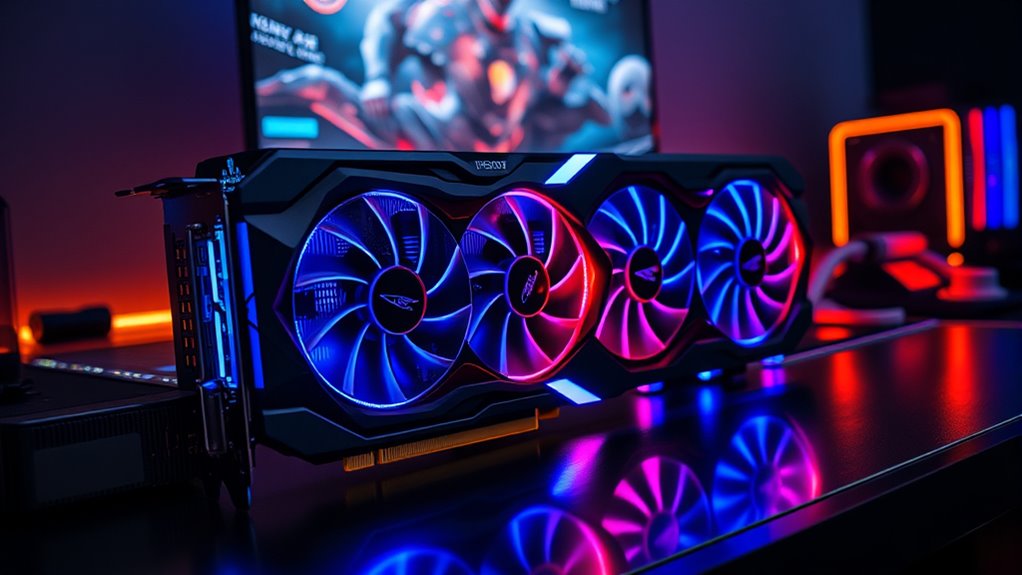
When choosing a premium graphics card, I focus on performance benchmarks to guarantee it meets my gaming needs. I also check compatibility requirements like my system’s power supply, cooling, and VRAM capacity to avoid issues. These factors help me pick a card that delivers top performance without any hiccups.
Performance Benchmarks
Performance benchmarks are essential tools for evaluating how well premium graphics cards handle demanding gaming tasks. They typically measure frame rates, like FPS, at various resolutions such as 1080p, 1440p, and 4K, giving a clear picture of real-world performance. Synthetic benchmarks like 3DMark or Unigine Heaven provide standardized scores, allowing for objective comparisons across models. These tests reveal the card’s ability to sustain high frame rates with settings like Ultra or high quality, ensuring smooth gameplay. Benchmarks also assess efficiency, including power consumption relative to performance, and thermal output under load. Consistent results across multiple tests help me determine if a graphics card is suitable for high-resolution gaming, ray tracing, and AI features, making benchmarks a crucial part of my decision-making process.
Compatibility Requirements
Choosing a high-end graphics card isn’t just about its raw power; compatibility with your system is vital to revealing its full potential. First, check that your motherboard supports the card’s interface, like PCIe 4.0 or PCIe 5.0, to guarantee optimal data transfer. Next, verify that your power supply provides the necessary connectors, such as 8-pin or 16-pin, and has enough wattage to handle the card’s requirements. Also, make sure your PC case has enough space and clearance, especially for larger models. Compatibility with your CPU and RAM is essential to avoid bottlenecks that can limit performance. Finally, review the card’s display outputs and maximum resolution to match your monitor setup for the best visual experience.
Cooling Solutions
Selecting the right cooling solution is essential for maximizing your high-end graphics card’s performance and longevity. Advanced cooling technologies like vapor chamber cooling, phase-change thermal pads, and multiple axial-tech fans excel at maintaining low temperatures during intense gaming. These solutions prevent thermal throttling, ensuring consistent performance. Efficient heat dissipation features, such as large fin arrays and high airflow designs, optimize cooling while keeping noise levels low, creating a quieter gaming experience. Customizable fan profiles and low-noise operation modes give you control over balancing cooling power and acoustics during long sessions. High-quality thermal interfaces, including phase-change pads and premium thermal pastes, improve heat transfer from the GPU to cooling components, boosting thermal stability. Proper case ventilation and airflow management complement these solutions, helping maintain ideal operating temperatures and extending component lifespan.
Power Supply Needs
When upgrading to a premium graphics card, it’s crucial to make certain your power supply can handle the increased demand. High-end GPUs typically require at least a 650W power supply, sometimes more, to operate reliably under load. Many of these cards need dedicated power connectors, like 8-pin or 16-pin (Gen 4), to deliver enough power for peak performance. Using adapters or lower-capacity PSUs can lead to fire hazards, system crashes, or hardware damage, especially with power-hungry cards. It’s important to confirm your power supply has enough PCIe power ports and wattage headroom for future upgrades or overclocking. Always verify that your PSU’s connectors and total wattage meet or exceed the GPU manufacturer’s recommendations for safe, stable operation.
VRAM Capacity
Upgrading your graphics card means considering not just raw power but also how much VRAM it has. VRAM determines how much texture and frame data the card can store, directly affecting performance, especially at higher resolutions. For 1080p gaming, 4GB to 8GB of VRAM usually suffices, but for 1440p or 4K, 12GB or more is ideal to handle large textures smoothly. More VRAM reduces stuttering and load times in modern games that use ultra-high-resolution textures and advanced effects. It’s also vital for creative tasks like 3D rendering, video editing, and AI work that process large datasets. However, VRAM should be balanced with GPU core performance and bandwidth to avoid bottlenecks and guarantee overall performance.
Price and Value
Choosing the right graphics card involves balancing performance with cost, as high-end models can vary substantially in price. Prices typically range from around $300 to over $1,000, so it’s crucial to evaluate your budget and gaming or creative needs. Value is often judged by comparing performance metrics like frame rates, resolution support, and features relative to the cost. A more expensive card may provide advanced features such as higher VRAM, better ray tracing, and improved cooling, which can justify the premium for certain users. However, budget-friendly options can still deliver excellent performance for 1080p gaming or creative tasks. Ultimately, the best value balances performance, durability, and features to meet your needs without overpaying, ensuring long-term satisfaction and cost-effectiveness.
Frequently Asked Questions
How Do Graphics Card Cooling Solutions Impact Performance and Noise Levels?
Cooling solutions directly impact both performance and noise levels. When I choose a good cooling system, my graphics card stays cooler, which lets it run at higher speeds without throttling. Quieter fans make my setup less disruptive, especially during intense gaming sessions. Efficient cooling also prolongs the card’s lifespan. So, I prioritize effective cooling to get ideal performance without sacrificing silence and durability.
What Is the Typical Lifespan of a High-End Gaming Graphics Card?
A high-end gaming graphics card usually lasts around 3 to 5 years, but I’ve seen some stay relevant even longer with proper care. Did you know that regular cleaning and driver updates can extend their lifespan? I recommend monitoring performance and temperatures to catch issues early. With good maintenance, your investment can keep delivering top-tier gaming experiences well beyond the typical lifespan.
Are There Significant Differences in Driver Support for Various Brands?
Yes, there are noticeable differences in driver support among brands. I’ve found that NVIDIA generally offers more stable and frequent updates, especially for gaming and new technologies. AMD’s drivers can sometimes be less consistent, but they’re improving. I recommend sticking with well-supported brands and keeping drivers updated to guarantee ideal performance and compatibility. Good driver support really makes a difference in gaming experience and system stability.
How Do Overclocking Capabilities Vary Among Premium Graphics Cards?
Overclocking capabilities among premium graphics cards are like a turbocharged engine—some have more horsepower waiting to be accessed. I’ve found that brands like ASUS and MSI offer robust overclocking tools and higher headroom, letting you push performance further. Others may be more conservative. If you’re looking to squeeze every ounce of power, choose a card with strong factory overclocking options and solid cooling.
What Future Technologies Might Influence Graphics Card Choices in 2025?
Future technologies like AI-driven rendering, advanced ray tracing, and DLSS 4.0 will heavily influence my graphics card choices in 2025. I expect more intelligent optimization, better visual fidelity, and improved efficiency. As these innovations emerge, I’ll look for cards that harness AI for smoother gameplay and stunning graphics. Staying updated on these tech trends will help me choose the most powerful and future-proof GPU for my gaming rig.
Conclusion
Choosing the right premium graphics card can feel overwhelming, but remember, “you get what you pay for.” Whether you’re after raw power or great value, the options listed here offer top-tier performance for 2025. Stay informed, weigh your needs carefully, and don’t rush your decision. Investing in the right GPU guarantees your gaming rig remains future-proof and ready for whatever games you throw at it. Happy gaming!