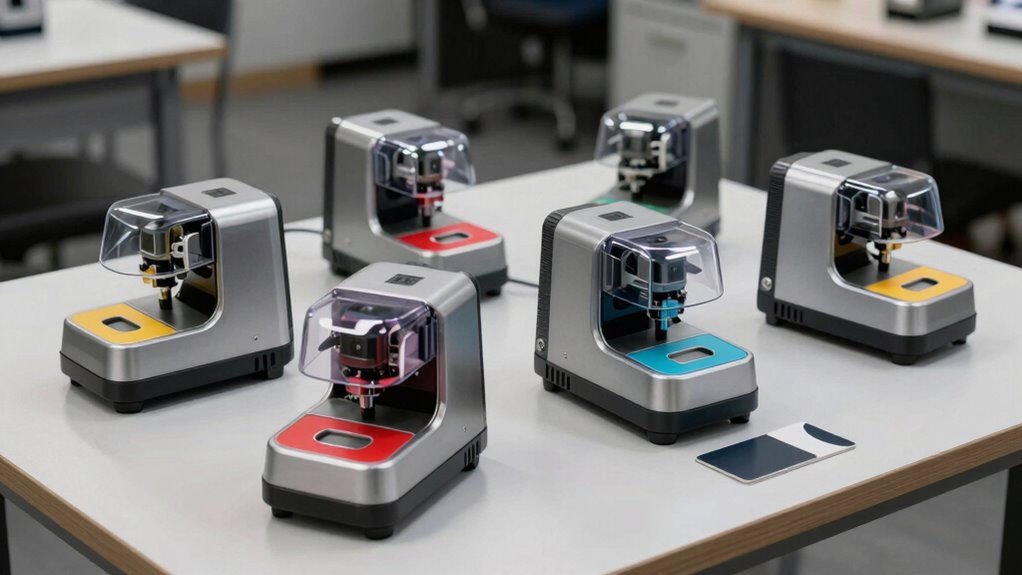

For a corner rounder machine for cards, I’d start with the PYY Heavy-Duty A3 Steel Punch: its R4, R6, and R10 dies offer more radius choice than the many two-die machines. The WILLBOND Heavy-Duty Punch is a straightforward pick if R6 and R10 cover your card designs, while the Sunstar Kadomaru Pro suits small craft batches where a compact handheld tool matters more than thick-stack capacity. The main tradeoff is between a sturdy press for thicker materials and a smaller punch that is easier to store and handle. I compare all 15 options below so you can match the tool to your card stock, batch size, and preferred corner shape.

Get business pricing on tools and workshop supplies
- Business-only prices and quantity discounts
- Tax-exempt purchasing
- Multiple users, one account, clear invoices
Complete the kit


Key Takeaways
- Three radius choices set PYY apart: its R4, R6, and R10 dies give card makers more control over the finished corner than the common R6/R10 pairing.
- Most heavy-duty models share a similar role: many list a 30 mm capacity and two dies, so die changes, holding aids, and the exact material limits matter more than broad heavy-duty claims.
- Thick-material capacity is not the same as card-stack capacity: a listed 30 mm maximum does not tell you how cleanly a particular stock or layered card cuts.
- Handheld and tabletop punches serve different workflows: the Sunstar Kadomaru Pro and QIQQIKIN favor compact craft use, while lever presses better suit repeated batches and thicker materials.
- Check the included dies before choosing: the tabletop model lists fractional-inch dies, while several other tools use metric radii; matching the radius to your design avoids buying for capacity you may not need.


| corner rounder machine for card | Operation | Weight |
|---|---|---|
| Heavy-Duty Corner Rounder Cutt | Manual | 3.99 kg |
| WILLBOND Heavy-Duty Corner Rou | Manual | 4.01 kg |
| Yorkmills Paper Corner Rounder | — | — |
| IRONWALLS Heavy Duty Manual Co | Manual | — |
| Corner Rounder Cutter Machine | Manual | — |
| PYY Corner Rounder Punch Cutte | — | 8 lb / 3.6 kg |
| Black Heavy-Duty Corner Rounde | — | 4.01 kg |
| Heavy Duty Corner Rounder Punc | — | 4.04 kg |
| Bonvoisin Corner Rounder Punch | — | 5.97 kg |
| Corner Rounder Cutter Machine | — | — |
| Sunstar Kadomaru Pro Corner Cu | Manual | 1.41 oz |
| Table Top Corner Rounding Mach | Manual | — |
| QIQQIKIN 3-in-1 Paper Corner R | Manual | 0.09 kg |
| BEAMNOVA Heavy Duty Corner Rou | Manual | — |
| IRONWALLS Corner Rounder Cutte | Manual | 4 kg |
More Details on Our Top Picks
Heavy-Duty Corner Rounder Cutter Machine, Black, 6 mm & 10 mm Radii, Up to 30 mm Thickness
For cards made from more than paper, the YARRD stands out with a stated capacity of 30 mm and compatibility with paper, cardstock, plastic, and thin metal. That range gives it a broader material brief than the Yorkmills Paper Corner Rounder, which lists paper, cardboard, film, PVC, and leather instead. The YARRD offers 6 mm and 10 mm radii, so it covers two common corner styles, though neither option suits buyers who need a smaller radius or more die choices. Its non-slip base, paper holder, and long handle are intended to steady material and provide leverage. The tradeoff is its large, heavy footprint; at nearly 4 kg, it is better suited to a dedicated bench than a compact card-making area, and thick cuts still call for manual effort.
Pros:- Stated capacity of up to 30 mm accommodates unusually thick material.
- Works with paper, cardstock, plastic, and thin metal.
- Two radius options cover both 6 mm and 10 mm corners.
- Non-slip base, paper holder, and extended handle support steadier manual cutting.
Cons:- Its 16.14 × 16.1 × 10 in dimensions take substantial workspace.
- At 3.99 kg and manually operated, it may be tiring to move or use for repeated thick cuts.
- Only two radii are specified.
Best for: Card makers and small workshops that round thick cardstock alongside plastic or thin metal and have a permanent work surface.
Not ideal for: Occasional crafters with limited storage, or anyone who needs a compact punch, a smaller radius, or low-effort repeated cutting.
- Brand:YARRD
- Model:DHCC-HaDA
- Operation:Manual
- Radius options:6 mm and 10 mm
- Maximum thickness:30 mm (1.2 in)
- Material:Metal
- Weight:3.99 kg
- Dimensions (H × W × D):16.14 × 16.1 × 10 in
Our verdict“Choose the YARRD if your card work includes thick or varied materials and you can dedicate bench space to a heavy manual cutter.”
WILLBOND Heavy-Duty Corner Rounder Paper Punch with Interchangeable R6 and R10 Dies
The WILLBOND’s adjustable baffle and paper press make it a sensible pick for card makers who care about keeping each piece aligned through a manual cut. Its interchangeable R6 and R10 dies provide the same two radii as the IRONWALLS Heavy Duty Manual Corner Rounder, while the WILLBOND specifically describes an adjustable baffle to position material. The extended handle is intended to reduce effort, and its metal construction with a cast iron base favors a planted setup. Its 30 mm cutting height matches the other heavy-duty machines here, but does not set it apart for capacity. At 4.01 kg and 11.42 × 8.66 × 7.48 in, it still needs dedicated space, and two dies limit shape choice. This is a practical alignment-focused option, not a compact or hands-free card punch.
Pros:- Includes interchangeable R6 and R10 dies.
- Adjustable baffle and paper press help hold and position material.
- Extended handle is designed to reduce cutting effort.
- Cast iron base and metal construction support a stable setup.
Cons:- Its 4.01 kg weight and listed dimensions make it a bench tool rather than an easy-to-store punch.
- Maximum cutting height is 30 mm, with no greater capacity than other heavy-duty options here.
- Only two die sizes are included.
Best for: Card makers producing repeated batches who want a manual press with an adjustable guide to help position stock consistently.
Not ideal for: Crafters who need several corner sizes, a lightweight portable tool, or an electric machine for frequent high-volume work.
- Brand:WILLBOND
- Model:JUQ-WILLBOND-58
- Operation:Manual
- Included dies:R6 (6 mm) and R10 (10 mm)
- Maximum cutting height:30 mm
- Material:Aluminum and metal
- Color:Iron gray
- Dimensions:11.42 × 8.66 × 7.48 in
- Weight:4.01 kg
Our verdict“Pick the WILLBOND if repeatable positioning matters more to your card batches than portability or a wide range of corner shapes.”
Yorkmills Paper Corner Rounder Cutter, R6mm R10mm, 1.2 in / 30 mm Thickness
Paper, cardboard, film, PVC, and leather are the materials named for the Yorkmills, giving card makers a clear craft-oriented use case. Its hardened steel blades and paper-pressing device are intended to support clean cuts and steadier placement. Compared with the YARRD Heavy-Duty Corner Rounder, Yorkmills lists leather among its compatible materials, while YARRD names thin metal; neither description makes this a one-size-fits-all choice for every material. Yorkmills includes R6 and R10 dies and cuts up to 30 mm, so it covers common rounded card corners and thick stacks. The tradeoff is limited choice: there are only two standard radii, and manual pressure may be demanding on thicker work. With no listed dimensions or weight, buyers cannot judge its storage needs from the supplied specifications.
Pros:- Compatible materials include paper, cardboard, film, PVC, and leather.
- Hardened steel blades are specified for the cutting dies.
- Paper-pressing device helps hold material steady.
- 30 mm cutting height accommodates thick stock.
Cons:- Only R6 and R10 standard dies are specified.
- Manual cutting may require considerable effort on thicker materials.
- The provided product data does not list dimensions or weight.
Best for: Paper crafters and card makers who also work with cardboard, film, PVC, or leather and want a heavy-duty manual press.
Not ideal for: Buyers who need a smaller or wider selection of radii, documented machine dimensions, or minimal effort on thick batches.
- Cutting height:30 mm (1.18 in)
- Standard cutting dies:R6 (6 mm radius) and R10 (10 mm radius)
- Handle:Lengthened ergonomic handle
- Construction:Heavy-duty metal
- Blade material:Hardened steel
- Paper control:Paper-pressing device
- Listed applications:Paper, cardboard, film, PVC, and leather
Our verdict“Choose Yorkmills for a manual card cutter aimed at paper and mixed craft materials, provided two corner sizes meet your needs.”
IRONWALLS Heavy Duty Manual Corner Rounder Punch with Interchangeable R6mm and R10mm Dies
The IRONWALLS is the straightforward choice for buyers who prioritize a steel body and carbide steel dies in a heavy-duty card corner punch. Its stated 30 mm capacity matches the WILLBOND and Yorkmills, but its listed material compatibility reaches beyond paper and cardstock to PVC, laminate, aluminum, and copper. That makes it relevant to a mixed-material bench, though buyers should match those materials to their own cutting needs. The included R6 and R10 dies cover familiar card finishes, but offer less range than a multi-die option such as the PYY Corner Rounder Punch, which is listed with R4, R6, and R10. The manual mechanism, handle, and paper-pressing device favor controlled positioning; the tradeoff is that batch cutting remains physical work and the two included radii may not suit every design.
Pros:- A3 steel body is specified for the machine.
- Interchangeable carbide steel R6 and R10 dies are included.
- 30 mm maximum thickness suits thick stacks and sheet material.
- Paper-pressing device and ergonomic handle support controlled manual cutting.
Cons:- Manual operation can be slow and physically demanding for large batches.
- Only two die radii are included, fewer than the three listed for the PYY option.
- The provided specifications do not give machine dimensions or weight.
Best for: Workshop users who round cards and other listed sheet materials and want a steel-bodied manual machine with carbide steel dies.
Not ideal for: Card makers seeking more than two corner radii, an electric workflow, or a small handheld tool for occasional use.
- Brand:IRONWALLS
- Operation:Manual
- Maximum thickness:30 mm (1.2 in)
- Included die radii:R6 (6 mm) and R10 (10 mm)
- Body material:A3 steel
- Die material:Carbide steel
- Listed compatible materials:Paper, cardstock, PVC, plastic, laminate, aluminum, and copper
Our verdict“Choose IRONWALLS for a fixed workshop where steel construction and the listed material range matter more than die variety or speed.”
Corner Rounder Cutter Machine – R6mm & R10mm, 30mm Thick, Heavy-Duty Paper, Card, PVC, ABS Sheet Corner Punch with Press
Paper, cardstock, PVC, and ABS define the Franc Moody’s stated material range, with a built-in press device intended to keep cuts consistent in school, office, or craft settings. Like the WILLBOND Heavy-Duty Corner Rounder, it offers R6 and R10 corners and a press for positioning; WILLBOND also lists an adjustable baffle and cast iron base, details not provided for this model. Franc Moody claims a 30 mm capacity, which makes it suitable on paper for thick material, but its listed compatible media are narrower than the YARRD’s range, which includes thin metal. The listing calls the unit compact and lightweight at 80 g, yet provides no dimensions to clarify its footprint. With just two radii and manual operation, it suits occasional batches better than continuous production.
Pros:- Built-in press device is intended to support consistent cuts.
- Listed media include paper, cardstock, PVC, and ABS.
- Stated capacity reaches 30 mm thickness.
- Manual operation requires no electricity.
Cons:- Only 6 mm and 10 mm radii are specified.
- Manual punching requires effort for each cut and may slow large production runs.
- The stated 80 g weight and compact description are not accompanied by dimensions.
Best for: Teachers, office staff, and craft groups rounding batches of cards or sheets made from paper, cardstock, PVC, or ABS.
Not ideal for: Users working with metal or a wider range of materials, or those who need more than two radii or a verified machine footprint.
- Brand:Franc Moody
- Model:C548
- Part number:C548
- Operation:Manual
- Radius options:6 mm and 10 mm
- Maximum thickness:30 mm
- Compatible media:Paper, cardstock, PVC, and ABS
- Material type:ABS, alloy steel, metal, and PVC
- Item weight:80 g
Our verdict“Choose Franc Moody for manual card batches on its listed media when the built-in press matters more than extra die choices or documented size.”
PYY Corner Rounder Punch Cutter with 3 Dies (R4/R6/R10) and Blades – Heavy-Duty A3 Steel, Up to 30 mm Thickness
The PYY stands out for card makers who want three corner sizes in one heavy-duty bench tool. Its R4, R6 and R10 dies give more choice than the two-radius Chambridge and Bonvoisin cutters, which can help match different card formats without buying another punch. The 35 cm handle is designed to reduce the effort of cutting thicker stacks, and the stated 30 mm capacity suits substantial batches of cardstock or other supported materials. That capacity and its 8 lb weight make it a better fit for a dedicated work surface than a portable craft kit. I would choose it for radius flexibility, while buyers who need only R6 and R10 may find the Bonvoisin’s positioning stopper more directly useful.
Pros:- Three included dies provide R4, R6 and R10 corner options
- Stated 30 mm capacity accommodates thick stacks and materials
- 35 cm handle is designed to reduce required hand force
- Anti-slip silicone pads help keep the base steady
Cons:- At 8 lb, it is cumbersome to transport regularly
- The 30 mm limit rules out thicker substrates
- Its larger capacity may be unnecessary for occasional single-card work
Best for: Card makers producing repeat batches who want R4, R6 and R10 options in one stable, long-handled machine
Not ideal for: Crafters who carry their tools between locations or make cards in only one or two corner sizes; its 8 lb body and extra die range may be unnecessary
- Included dies:R4, R6, R10
- Maximum cutting thickness:30 mm / 1.2 in
- Stated batch capacity:Up to 300 sheets
- Blade material:A3 tool steel
- Handle length:35 cm / 13.7 in
- Dimensions:6.1 × 9.8 × 6.3 in
- Weight:8 lb / 3.6 kg
- Base pads:Anti-slip silicone
Our verdict“Choose the PYY if you need three radius choices and batch capacity at a fixed workstation; skip it if portability or simple one-off card cutting matters more.”
Black Heavy-Duty Corner Rounder Cutter, 6mm & 10mm Radius, 30mm (1.2″) Thickness, Metal Commercial Corner Punch for Plastic, Metal, Paper, Cardstock
The Chambridge is aimed at card makers whose work extends beyond paper: its description lists cardstock alongside plastic, leather and metal, with a 30 mm maximum thickness. That makes it a broad-use manual cutter, while the PYY offers more choice in corner size with three dies instead of Chambridge’s 6 mm and 10 mm radii. The non-slip holding device and extended handle support controlled cutting, but the listed dimensions—about 16 inches on each side—make this a substantial fixture rather than a small desktop punch. I would favor it when the same machine needs to serve varied material projects. For paper-card batches alone, the Heavy Duty Corner Rounder Punch with R6 and R10 dies also offers a cast-iron base and adjustable angle barrier, with a more specific card-and-sheet focus.
Pros:- Listed for paper, cardstock, cardboard, plastic, metal and leather
- 30 mm maximum material thickness
- Two radius choices cover common 6 mm and 10 mm corners
- Non-slip holding device and extended handle support controlled manual cutting
Cons:- Large listed dimensions take up substantial workspace
- At 4.01 kg, it is heavy to move between work areas
- Manual cutting thick materials requires physical effort
Best for: Makers who round cards and also work with listed materials such as plastic, leather or metal
Not ideal for: Card makers with limited bench space or those who need a lightweight tool for portable craft sessions
- Operation mode:Manual
- Blade radius options:6 mm and 10 mm
- Maximum material thickness:30 mm / 1.2 in
- Listed materials:Aluminum, metal
- Dimensions:16.1 × 16.1 × 16.14 in
- Weight:4.01 kg
- Color:Black
Our verdict“Pick the Chambridge when one machine needs to handle cards and several other listed materials, provided you have room for its large base.”
Heavy Duty Corner Rounder Punch, R6/R10 Dies, 1.2 in Capacity
For card makers who value repeatable alignment, this punch pairs R6 and R10 dies with an adjustable angle barrier. That guide gives it a useful edge for keeping repeated card corners consistent, while the PYY is the stronger choice if R4 is also part of the plan. Its description names paper and cardstock as well as foam core, PVC, ABS, magnetic sheets and aluminum, and the 1.18-inch cutting height supports thick work. There is a data mismatch to keep in mind: the specs list a sheet count of one, so I would not assume its tall capacity means it cuts hundreds of paper sheets at once. The cast-iron base favors steady bench use, but at 4.04 kg it is less convenient to put away than a compact hand punch.
Pros:- Adjustable angle barrier supports repeatable positioning
- Includes R6 and R10 dies for two common corner sizes
- Cast-iron base provides a stable platform
- Description lists cardstock and several rigid sheet materials
Cons:- Listed sheet count is one, so high paper-stack capacity is not established
- At 4.04 kg, it is not convenient for frequent transport
- The 1.18-inch capacity excludes thicker substrates
Best for: Card makers who repeat layouts and want an adjustable guide to help align corners consistently
Not ideal for: Buyers seeking a lightweight portable punch or a verified high sheet count for paper production
- Operation mode:Manual
- Included dies:R6 (1/4 in) and R10 (3/8 in)
- Cutting height capacity:1.18 in
- Sheet count:1
- Material type:Metal
- Weight:4.04 kg
- Color:Black
Our verdict“Choose this model for guided, repeatable R6 or R10 card work, but look elsewhere if you need a confirmed multi-sheet capacity or lighter tool.”
Bonvoisin Corner Rounder Punch – Heavy Duty Corner Cutter for Craft, Manual Paper Cutter with Replaceable Blade Set, 1-Inch Max Cutting Height
Bonvoisin’s metal stopper makes this a sensible pick for card makers who want a clear positioning aid when trimming repeated corners. It comes with replaceable R6 and R10 steel blades and lists paper, PVC, cards and thin aluminum among its supported materials. The one-inch maximum thickness is close to the 30 mm capacity of the Chambridge and PYY, though the Bonvoisin is heavier at 5.97 kg and offers only two radii. For a buyer who needs R4 as well, PYY’s three-die set is more flexible; for someone prioritizing alignment with familiar R6/R10 corners, the stopper may matter more. Its manual operation and weight suit a dedicated table, and replacement blades add a maintenance cost over time.
Pros:- Metal stopper aids consistent card positioning
- Includes replaceable R6 and R10 steel blades
- Works with listed materials including paper, PVC, cards and thin aluminum
- One-inch maximum cutting thickness supports substantial stacks
Cons:- At 5.97 kg, it is the heaviest option in this group
- Only two blade sizes are included
- Replacement blades add ongoing maintenance expense
Best for: Card makers producing repeat R6 or R10 cuts who want a physical stopper for positioning
Not ideal for: Portable-kit users, makers who need an R4 radius, or buyers who want to avoid replaceable-blade upkeep
- Included blades:R6 (6 mm), R10 (10 mm)
- Maximum cutting thickness:1 in
- Operation mode:Manual
- Sheet count:2
- Material type:Metal
- Weight:5.97 kg
- Color:Green
- Included components:Corner rounder machine, R6 and R10 blades
Our verdict“Choose Bonvoisin for stopper-guided R6 and R10 card work at a fixed bench, and choose the PYY if you need three radii or easier handling.”
Corner Rounder Cutter Machine – Heavy Duty for Paper, Cardstock, PVC, and More
This machine keeps its card-making offer straightforward: A3 steel construction, adjustable baffles and two radius choices, 6 mm or 10 mm. Those options cover common rounded card corners, while PYY adds an R4 die for makers who want a smaller curve. The listed 30 mm cutting range suggests capacity for thick material, and the description names paper, cardstock and laminated surfaces among its uses. Its handle is 10.43 inches, shorter than PYY’s 35 cm handle, so buyers cutting dense stacks may prefer PYY’s longer leverage. The specs give a height of 16.14 inches and a 16.1 by 10 inch base, which points to a sizeable setup; no weight or sheet count is provided. I’d shortlist it for routine R6/R10 jobs where the adjustable baffles fit the workflow.
Pros:- A3 steel construction is specified
- 6 mm and 10 mm radius options suit common card corners
- 30 mm listed cutting range handles thick materials
- Adjustable baffles support accurate placement
Cons:- Only two radius options are listed
- The 10.43-inch handle is shorter than PYY’s 35 cm handle
- Large listed dimensions and missing weight data make workspace planning harder
Best for: Home studios or small offices that regularly round paper and cardstock with either a 6 mm or 10 mm corner
Not ideal for: Makers who need R4 corners, a compact portable tool, or published weight and batch-capacity details before buying
- Material:A3 steel
- Cutting range:30 mm
- Radius options:6 mm or 10 mm
- Height:16.14 in
- Base dimensions:16.1 × 10 in
- Handle length:10.43 in
Our verdict“Choose this cutter for a direct R6/R10 card workflow with adjustable baffles, but favor the PYY for added radius choice and a longer handle.”
Sunstar Kadomaru Pro Corner Cutter with Authentic Hologram
The Sunstar Kadomaru Pro suits card makers who want a small handheld tool for clean, consistent corners on paper and thin laminated cards. Its compact footprint makes it easier to store and handle than the Table Top Corner Rounding Machine, which offers interchangeable dies and higher-volume cutting. The Sunstar handles up to three sheets of 20 lb paper or laminate up to 3.9 mil thick, so it fits short craft runs rather than batch production. Its metal construction and simple press action keep the job straightforward, but the limited capacity and single cutting profile leave less room to adapt than the QIQQIKIN 3-in-1 punch, which offers three radii. Choose this model for tidy, lightweight card projects; skip it if you need thick stacks or multiple corner styles.
Pros:- Cuts up to three sheets of 20 lb paper in one press
- Handles laminated material up to 3.9 mil thick
- Compact handheld size is easy to store
- Metal construction supports regular craft use
Cons:- Limited to three sheets at a time
- Offers less radius flexibility than the QIQQIKIN 3-in-1 punch
Best for: Card crafters who want a compact manual tool for occasional paper and thin laminated card projects.
Not ideal for: Print shops or makers working with thick materials, large batches, or several corner radii.
- Operation:Manual
- Sheet capacity:Up to 3 sheets of 20 lb bond paper
- Laminate capacity:Up to 3.9 mil
- Material:Metal
- Dimensions:4.72 × 3 × 7.09 in
- Weight:1.41 oz
- Model:S4765036
Our verdict“Choose the Sunstar for compact, low-volume card finishing with a simple press action.”
Table Top Corner Rounding Machine Corner Cutter with 3 Dies
For repeated card runs, the tabletop machine’s multi-sheet capacity is its main advantage: the listing says it can cut up to 110 sheets of paper, far beyond the Sunstar Kadomaru Pro’s three-sheet limit. It comes with three interchangeable dies—3 mm, 6 mm, and 10 mm—so a maker can switch corner styles without buying a separate punch. The listing also names PVC, polyester, leather, polypropylene, and paper, giving it broader material coverage than the paper-focused Sunstar. That capacity and versatility come with a larger tabletop format, which is less convenient for occasional home crafting than the compact QIQQIKIN 3-in-1 punch. The product data gives no dimensions or construction details, so buyers have less information about storage needs and build. It makes sense for organized, repeatable batches where die changes matter.
Pros:- Listing states capacity of up to 110 sheets of paper
- Includes 3 mm, 6 mm, and 10 mm dies
- Interchangeable dies accommodate different card corner styles
- Listing names paper, PVC, polyester, leather, and polypropylene as compatible materials
Cons:- Tabletop format is less portable than the Sunstar Kadomaru Pro
- Product data omits dimensions and construction material
- No specific maximum material thickness is provided
Best for: Small card and ID production teams that process repeated paper or plastic batches and need three included corner sizes.
Not ideal for: Occasional hobby crafters with limited workspace who prefer a compact handheld punch.
- Operation:Manual
- Included dies:3 mm, 6 mm, and 10 mm
- Paper capacity:Up to 110 sheets, according to the listing
- Compatible materials:PVC, polyester, leather, polypropylene, and paper
- Die system:Interchangeable
- Format:Tabletop
Our verdict“Pick this tabletop cutter for repeated card batches that benefit from high stated paper capacity and three included radii.”
QIQQIKIN 3-in-1 Paper Corner Rounder Punch (R4mm, R7mm, R10mm)
The QIQQIKIN 3-in-1 is a practical starting point for card makers who want to experiment with corner styles using one small manual punch. Its 4 mm, 7 mm, and 10 mm radii give more choice than the single-profile Sunstar Kadomaru Pro, while its 2 mm thickness limit keeps it aimed at paper, foam, and foil rather than the heavy stacks handled by the BEAMNOVA machine. The zinc alloy body and stainless steel blade are specified, and the compact 2.8-inch length suits a craft drawer or portable kit. Sticky papers may jam, very thin paper can need layering, and materials must stay under 2 mm. That makes this a flexible tool for light projects, but not a production punch for thick card stock or fast batch work.
Pros:- Three radii cover varied card and paper styles
- Stainless steel blade is specified for clean cuts
- Zinc alloy body in a compact handheld format
- Works with paper, EVA foam, and foil up to 2 mm thick
Cons:- Sticky papers may jam the mechanism
- Materials must remain under 2 mm thick
- Very thin paper may need layering for reliable cuts
Best for: New card crafters who want three corner sizes in a compact tool for paper, light foam, and foil.
Not ideal for: Makers who routinely punch sticky stock, thick layered cards, or large batches.
- Operation:Manual
- Corner radii:4 mm, 7 mm, and 10 mm
- Maximum thickness:2 mm
- Compatible paper weight:70–230 g
- Materials:Zinc alloy body, stainless steel blade
- Dimensions:2.8 × 2.4 × 1.4 in
- Weight:0.09 kg
Our verdict“Choose the QIQQIKIN if you want an approachable small punch with three radius options for lightweight projects.”
BEAMNOVA Heavy Duty Corner Rounder Industrial Paper Punch Cutter Machine
The BEAMNOVA industrial rounder is the heavy-material choice in this group. Its listed 30 mm maximum thickness and A3 steel construction put it in a different class from the QIQQIKIN, which tops out at 2 mm, and make it relevant for thick card assemblies and listed materials such as PVC and aluminum sheets. The iron-casting base, adjustable baffle, and paper-pressing device are intended to keep work positioned during a manual cut. Two dies, R6 and R10, cover common rounded corners, though the Table Top Corner Rounding Machine arrives with three sizes and is described for a wider range of materials. The BEAMNOVA’s 16.14-inch height and substantial bench-style build demand dedicated space; it is excessive for simple paper-only card crafts.
Pros:- Listed cutting thickness reaches 30 mm
- A3 steel body and iron-casting base provide a substantial stationary setup
- Includes R6 and R10 dies
- Adjustable baffle and pressing device help position material
Cons:- Large 16.14-inch height takes dedicated workspace
- Only two dies are included
- Manual operation is less suited to fast, high-volume production
Best for: Makers or small workshops finishing thick card, PVC, or other listed materials that need a stable manual bench machine.
Not ideal for: Home card crafters with limited desk space or projects that only involve thin paper.
- Operation:Manual
- Maximum cutting thickness:30 mm (1.2 in)
- Included dies:R6 (1/4 in) and R10 (3/8 in)
- Construction:A3 steel / alloy steel
- Base:Iron casting
- Dimensions:10 × 6.1 × 16.14 in
- Brand:BEAMNOVA
Our verdict“Choose the BEAMNOVA when thick material capacity and a stable bench setup matter more than compact storage.”
IRONWALLS Corner Rounder Cutter Machine – R6mm & R10mm – 1.2″/30mm Thickness Heavy Duty Paper Corner Punch with Holding Device
The IRONWALLS cutter offers the same headline 30 mm capacity and R6/R10 dies as the larger BEAMNOVA, but its listed height is 13.39 inches rather than 16.14 inches. That makes it the more compact of these two heavy-duty machines for a workshop bench, though its 4 kg carbon steel build still favors a fixed work area over portability. The holding device and long handle are meant to steady material and reduce effort during manual cuts; the listing also names foam core, PVC, ABS, and thin metal among compatible materials. Compared with the tabletop three-die cutter, IRONWALLS offers much greater stated thickness but fewer included radii. Its two-size setup is best for repeat jobs that use common corner shapes, not makers who need frequent style changes.
Pros:- Handles materials up to 30 mm thick according to the listing
- Includes common R6 and R10 dies
- Holding device helps keep material from slipping
- Lower listed height than the BEAMNOVA machine
Cons:- At 4 kg, it is not convenient for frequent transport
- Only two radius sizes are included
- Manual cutting can be slow for large production runs
Best for: Workshop users who cut thick cards or listed sheet materials and want a heavy-duty machine with a lower profile than the BEAMNOVA.
Not ideal for: Portable craft users or card makers who need more than R6 and R10 corner options.
- Operation:Manual
- Cutting sizes:R6 (1/4 in) and R10 (3/8 in)
- Maximum cutting thickness:30 mm
- Material:Carbon steel
- Sheet capacity:30 sheets
- Dimensions:10.24 × 6.3 × 13.39 in
- Weight:4 kg
Our verdict“Pick the IRONWALLS for thick, repeatable card work when a compact heavy-duty bench machine suits your workspace.”

How We Picked
I ranked these machines around the job implied by this roundup: rounding card corners cleanly and repeatably. I weighed radius choices, stated material and thickness capacity, operating format, replaceable or interchangeable dies, and features that can help hold stock in place. For card makers, the ability to get the intended corner shape consistently matters more than a broad claim that a tool cuts many material types.
The order favors versatility and practical control first, then simpler two-radius presses, specialty production or craft formats, and compact handheld punches. The PYY leads for offering three metric radii; two-die machines follow when they pair substantial stated capacity with useful setup details. Product titles alone do not establish cut quality across every stock, so I treat capacity and material lists as selection clues, not guarantees. Where listings provide little detail about included parts or workflow, I rank them lower because buyers have less information to match the tool to their cards.
Factors to Consider When Choosing Corner Rounder Machine For Cards
I’d choose a corner rounder by starting with the cards you actually make: their stock, finished dimensions, batch size, and desired corner profile. These broader checks can prevent a mismatch that a long material list or a heavy-duty label may conceal.
Match the Radius to the Card Design
Radius affects the look of a card as much as its handling: a small curve keeps a formal, restrained shape, while a larger curve reads softer and removes more of the corner. Before buying, measure or mock up the corner you want on scrap from the same card stock. Metric R4, R6, and R10 options are not interchangeable with fractional-inch dies, so compare the actual dimensions rather than assuming the nearest label will look identical. A three-die set gives flexibility for different designs, but it adds little value if every card uses one established radius. When a set will be shared across invitations, labels, and playing-card-sized projects, broader radius choice can justify a more involved press.
Read Capacity as a Starting Point
A stated thickness limit describes a maximum claim, not a promise that every material at that thickness will cut cleanly. Dense laminated stock, layered cardstock, and flexible plastic can behave differently under a punch even when their measured thickness is similar. If the product listing does not specify a tested combination, plan to try the exact material on offcuts before committing a finished batch. Buyers often focus on the largest capacity and overlook whether their everyday cards are thin enough for a smaller tool. Pick around your regular stock and treat extra capacity as headroom, not the main reason to buy.
Estimate Batch Size and Repetition
For occasional handmade cards, a compact punch may be easier to keep nearby and quicker to set up than a tabletop press. Repeated batches change the calculation: a stable base, comfortable lever action, and a way to align or hold each card can reduce handling effort and variation. A high sheet-count claim is useful only when it refers to the paper and setup you intend to use. If you make several card sizes, check how easily the stock can be positioned against the cutting area for each size. Choose the simplest tool that fits the pace you expect; an industrial-style machine can take up space without helping a low-volume workflow.
Check Die Changes and Replacement Parts
Interchangeable dies make one machine more adaptable, but only if the changes are practical and replacement parts remain available. Before buying, check whether the listed set includes every radius you need, how blades or dies are replaced, and whether the product names a compatible replacement set. These details matter when a tool will be used frequently, since a worn cutting part can affect edges and leave the machine idle. A fixed-radius handheld punch avoids setup steps but ties you to its one profile. For a shared studio, clear part compatibility may be more useful than one additional radius.
Consider Work Surface, Alignment, and Storage
Lever presses need a firm, level surface and enough clearance for the handle to move through its full stroke. A holding device or alignment aid can help keep small cards in position, but it cannot replace checking that the card edge sits squarely against the guide. Compact punches are easier to store, though positioning each corner by hand can take more attention across a large batch. Measure the tool footprint and handle travel before choosing a tabletop model for a crowded workbench. A machine that is easy to set up and return to storage is more practical if card making shares space with other projects.
Choose Materials by Your Main Use
Product listings that mention PVC, ABS, plastic, or metal can suggest wider use, but the wording does not tell you how each material cuts or whether special dies are required. If cards are your main project, prioritize clear fit with paper and cardstock, then confirm other materials directly with the manufacturer or seller. Cutting non-paper stock can leave residue or wear a blade differently, so avoid assuming one tool will be equally suited to all of them. A dedicated paper punch may be a better fit for clean, repeatable card work than a machine selected for the broadest material list. If your projects truly mix materials, replacement parts and documented compatibility should carry more weight in your decision.
Frequently Asked Questions
Do I need R4, R6, or R10 corners for handmade cards?
There is no single radius that suits every card design. I’d compare sample cuts on the actual card stock, since the same radius can feel more or less prominent on a small card than on a larger one. R4 gives a tighter curve, while R10 removes more of the corner; R6 sits between those profiles. A three-radius set helps if you make varied designs, but a two-radius machine can be enough when you have a consistent house style.
Can a machine rated for 30 mm cut a stack of cards that thick?
A 30 mm capacity is a stated maximum and does not tell you the best stack height for clean card corners. Paper weight, coating, lamination, and how firmly the sheets sit together can all affect the cut. Start with a small stack of offcuts and add sheets gradually, checking that the edges stay aligned and the cut remains clean. For finished cards, consistency across the batch may matter more than getting through the maximum number of sheets in one press.
Should I choose a tabletop press or a handheld corner punch?
Choose based on how often you cut and how much setup space you have. A tabletop press is a better match for repeated batches, thicker materials, or workflows where a stable lever action helps. A handheld punch is easier to store and can suit occasional craft projects, though you position each cut by hand. If you regularly make many cards, consider how the tool will support alignment and reduce repetitive handling, not just how small it is.
Are metric radius dies compatible with fractional-inch dies?
Do not assume they are compatible just because the measurements seem close. Die shape, mounting, and machine design can differ, and an R6 die is not automatically a substitute for a fractional-inch die. Check the product documentation for the exact die system and compatible replacements before buying extras. If you are choosing between listings with different measurement systems, make sample corners first so the finished shape matches your design.
Is one corner rounder suitable for cardstock and plastic cards?
Some listings describe machines for both paper and plastic, but that does not confirm performance with every plastic type or thickness. If plastic cards are part of your workflow, verify that the machine and its included die are rated for your specific material. A tool marketed broadly for many materials may involve more setup or blade maintenance than a paper-focused punch. Test an offcut before using the machine on a finished card, and check how replacement blades are sourced if you expect regular mixed-material use.
Conclusion
For most card makers who want one machine for several corner profiles, I’d choose the PYY Heavy-Duty A3 Steel Punch as the best overall option because its R4, R6, and R10 dies cover more design choices. The WILLBOND Heavy-Duty Punch is my best value-style pick for buyers who only need the common R6 and R10 sizes, while the Sunstar Kadomaru Pro is the best beginner choice for compact, occasional craft work. For frequent batches or a production bench, compare the heavy-duty tabletop presses, giving extra weight to holding aids, die changes, and replacement parts; the IRONWALLS model with a holding device is the specific option to inspect for alignment support. Choose the tabletop model with fractional-inch dies if that system matches your project, and skip extra capacity or radii you are unlikely to use. My recommendation is to test the desired radius on scrap first, then buy for your normal card stock and batch size.