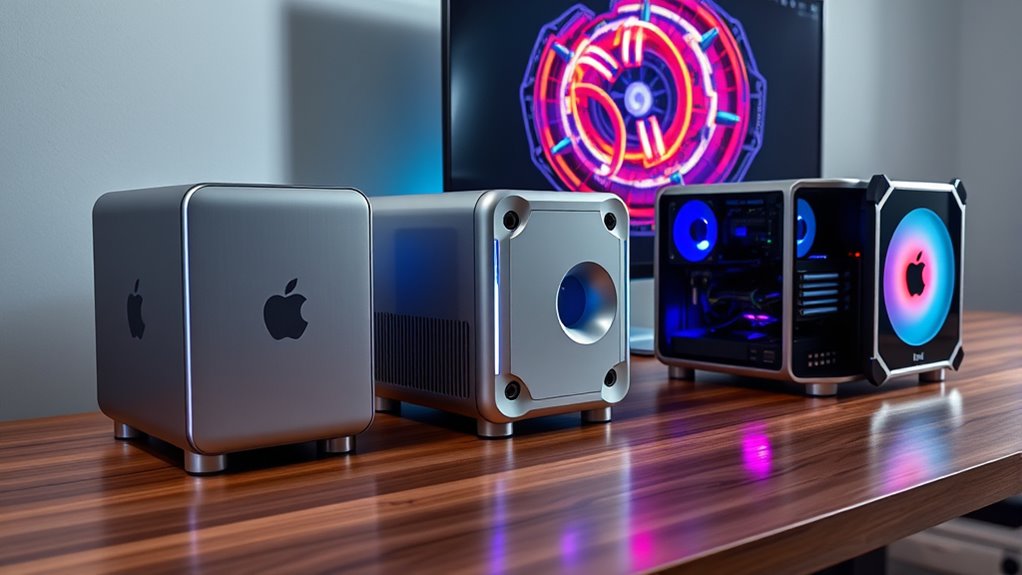

If you’re looking for the best Mac models for 3D design and simulation in 2025, I recommend considering the latest Mac Mini with the M4 chip, due to its strong performance, compact size, and high connectivity. Also, the Mac Studio and Mac Pro provide powerful expandability and top-tier specs for demanding workflows. To find out which one is the ideal fit for your needs and budget, keep exploring the options I’ve outlined.
Key Takeaways
- Prioritize Mac Pro models with high-core CPUs, extensive RAM (32GB+), and multiple PCIe slots for GPU expansion.
- Choose configurations with advanced connectivity options like 10Gb Ethernet and Thunderbolt 4 for fast data transfer.
- Opt for models supporting professional-grade GPUs with 16GB+ VRAM for demanding 3D rendering and simulations.
- Consider models with expandable storage and memory to future-proof high-performance 3D workflows.
- Balance budget with features, focusing on models that offer top-tier processing, graphics, and connectivity suited for 2025 needs.
Apple Mac mini Desktop Computer with M4 Chip (512GB SSD, 16GB RAM)
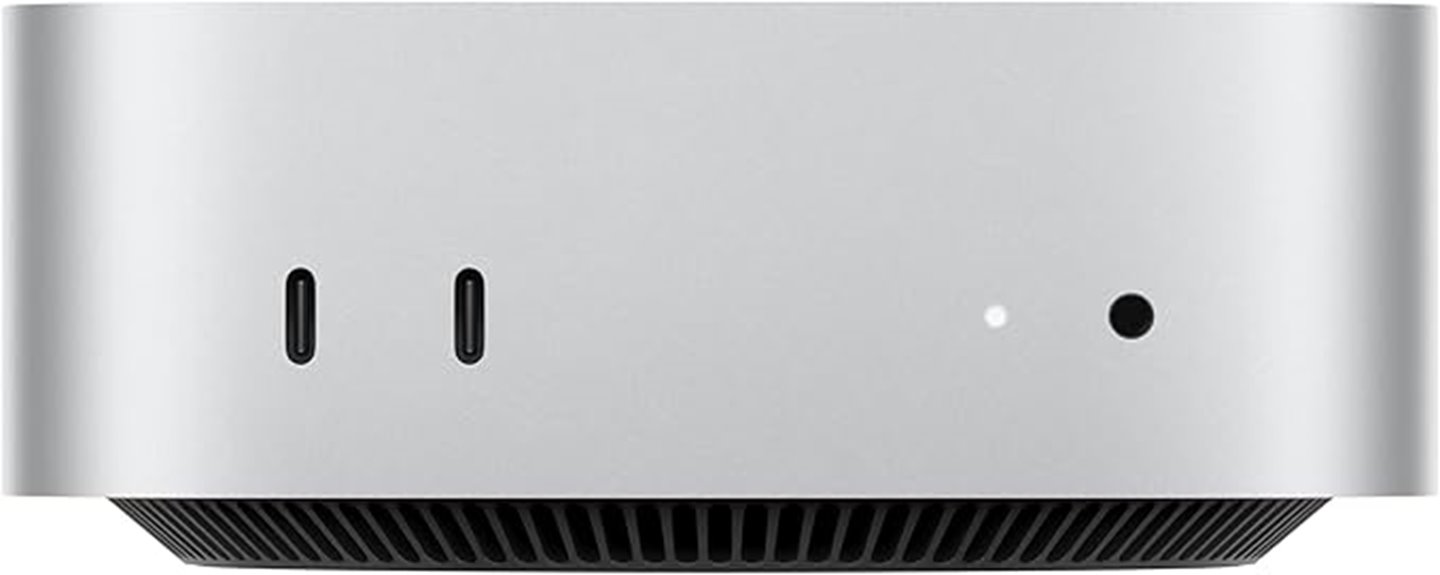
If you’re looking for a compact yet powerful option for 3D design and simulation, the Apple Mac mini with M4 chip is an excellent choice. Its small size, just 5 by 5 inches and 2 inches thick, makes it perfect for tight spaces while still packing impressive performance. Powered by the M4 chip with a 10-core CPU, 10-core GPU, and hardware-accelerated ray tracing, it can handle demanding tasks. Plus, with 16GB RAM (expandable to 24 or 32GB) and a fast 512GB SSD, it offers quick response times. Supporting multiple high-resolution displays and seamless connectivity, it’s a versatile tool for any creative workflow.
Best For: creative professionals and designers who need a compact, high-performance computer for 3D design, simulation, and multimedia workflows.
Pros:
- Small, space-saving design ideal for tight workspaces and versatile placement
- Powerful M4 chip with 10-core CPU and GPU, supporting demanding creative tasks
- Supports multiple high-resolution displays and fast connectivity options
Cons:
- Limited expandability beyond RAM and storage configurations
- No dedicated graphics card, which may impact extremely intensive 3D rendering
- Slightly higher price point compared to traditional mini PCs with similar specs
Apple Mac mini Desktop Computer with M4 Chip
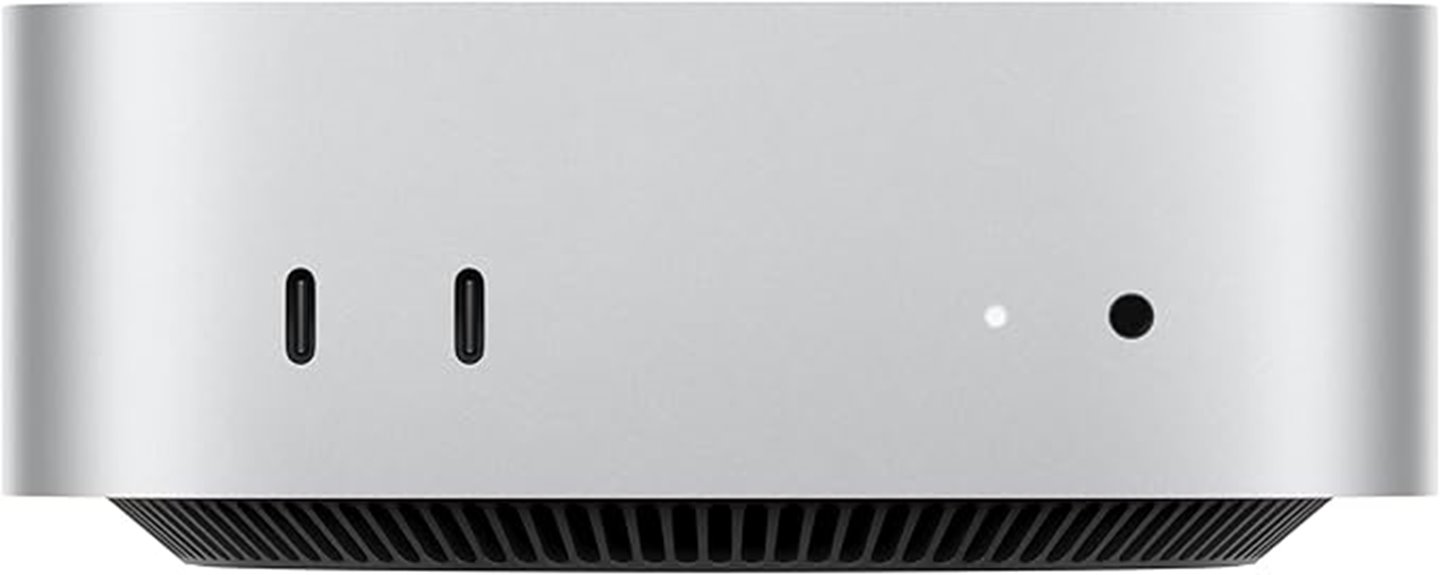
The Apple Mac mini with M4 chip is an excellent choice for 3D designers and simulation professionals who need powerful performance in a compact form factor. Its 10-core CPU and GPU, combined with hardware-accelerated ray tracing, deliver fast rendering and smooth multitasking. The 16-core Neural Engine enhances AI tasks, while 24GB of unified memory guarantees efficient workflows. With multiple Thunderbolt 4 ports, HDMI, and USB-C connections, it supports up to three displays and fast data transfer. Its small size—just 5 by 5 inches—fits easily on any desk, making it ideal for space-conscious setups without sacrificing power.
Best For: creative professionals like 3D designers and simulation experts who need compact yet powerful hardware for demanding workloads.
Pros:
- Compact size with a sleek design fits easily into any workspace
- Powerful M4 chip with 10-core CPU and GPU ensures high performance for rendering and multitasking
- Supports up to three high-resolution displays for enhanced productivity
Cons:
- Limited upgradability due to integrated components and fixed memory options
- Higher cost compared to traditional mini PCs with similar specifications
- Limited ports on the front may require additional adapters for extensive peripheral connectivity
Apple Mac mini Desktop Computer with M4 Chip (2024)

Designed for professionals who need compact yet powerful hardware, the 2024 Mac mini with M4 chip offers impressive performance in a small form factor. Its sleek five-by-five-inch design fits neatly beside monitors and integrates easily into any workspace. Powered by the M4 chip’s 10-core CPU, GPU, and Neural Engine, it handles demanding tasks like 3D rendering and simulations smoothly. With up to 32GB of unified memory and multiple high-resolution display support, it’s versatile for creative workflows. Extensive ports—including Thunderbolt 4, HDMI, Ethernet, and USB-C—ensure seamless connectivity. Despite its tiny size, this Mac mini delivers robust power, making it ideal for professional 3D design and media tasks.
Best For: professionals and creatives seeking a compact, powerful desktop computer capable of handling demanding tasks like 3D rendering, media editing, and multitasking with high-resolution displays.
Pros:
- Compact five-by-five-inch design fits easily into any workspace without sacrificing performance
- Powered by the advanced M4 chip with a 10-core CPU, GPU, and Neural Engine for fast, efficient processing
- Supports multiple high-resolution displays and extensive connectivity options including Thunderbolt 4 and HDMI
Cons:
- Limited upgradeability in terms of internal storage and memory after purchase
- No dedicated graphics card options, which may affect performance in high-end gaming or specialized GPU tasks
- Premium price point may be a consideration for budget-conscious users
Factors to Consider When Choosing a Mac Pro for 3D and Simulation
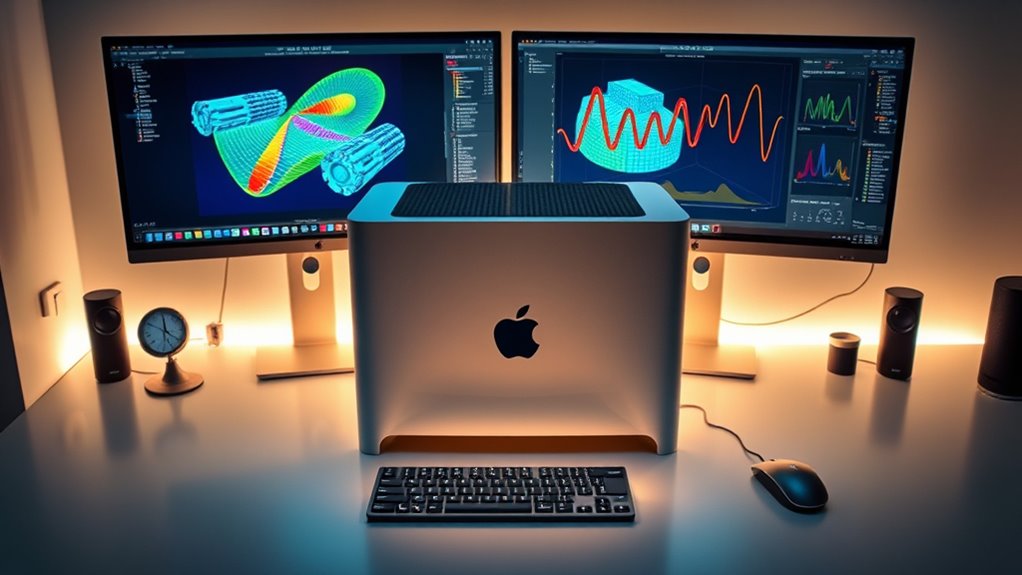
When selecting a Mac Pro for 3D design and simulation, I focus on several key factors. You need to take into account your processing power needs, graphics capabilities, and how much memory and storage you’ll require. Additionally, it’s important to evaluate compatibility, expansion options, and your budget to get the best fit for your projects.
Processing Power Needs
Choosing a Mac Pro for 3D design and simulation hinges on understanding your processing power needs. Complex rendering and simulations demand higher core counts and faster clock speeds to boost performance. Multi-threaded applications benefit from processors with multiple cores, allowing parallel processing of demanding tasks. Hardware acceleration features, like dedicated ray tracing cores, can markedly improve real-time rendering efficiency. Ensuring your CPU can handle large models without bottlenecks is essential, especially in real-time environments. To achieve smooth workflows and faster computations, balancing CPU power with ample RAM and robust GPU capabilities is vital. Evaluating your specific workload will help determine whether you need a high-core-count processor for heavy-duty tasks or a more balanced setup for versatile 3D and simulation work.
Graphics Capabilities
To achieve smooth 3D rendering and accurate simulations, a high-performance graphics card with plenty of VRAM—16GB or more—is vital. This guarantees complex models and detailed visuals render without lag. Support for multiple high-resolution displays, like 6K or 8K, demands a GPU with sufficient bandwidth and multiple outputs to handle the data flow smoothly. Hardware-accelerated ray tracing enhances realism, providing more accurate reflections and lighting effects essential for professional visualization. Compatibility with graphics APIs like Metal, OpenCL, or CUDA (where applicable) guarantees peak performance and stability during demanding tasks. The GPU’s architecture and driver support also influence how well it manages real-time rendering, simulation, and post-processing. Choosing the right graphics capabilities ensures your Mac Pro can handle the most intensive 3D workflows confidently.
Memory and Storage
High-performance memory and storage are key to maintaining smooth workflows in 3D design and simulation. I recommend at least 32GB of RAM for complex projects, as adequate memory prevents bottlenecks during rendering and simulations. Faster storage options like NVMe SSDs are essential, since they drastically cut load and save times for large files. Opting for larger capacities—1TB or more—ensures you have enough space for high-resolution textures, models, and simulation data without constantly relying on external drives. Additionally, memory bandwidth, measured in GB/s, influences how quickly data moves between RAM and processing cores, impacting speed. Configurable memory options allow tailoring the Mac Pro to your specific workload demands, providing the flexibility needed for intensive 3D tasks.
Compatibility & Expansion
When selecting a Mac Pro for 3D design and simulation, it’s pivotal to guarantee it offers sufficient expansion options to meet demanding workflows. Make certain it has enough PCIe slots to support multiple high-performance GPUs, which are indispensable for rendering and complex computations. Check for multiple Thunderbolt 4 and USB-C ports to connect external peripherals, storage, and auxiliary hardware seamlessly. Confirm that the system supports high-speed networking like 10Gb Ethernet for rapid data transfer between workstations and servers. Compatibility with professional-grade hardware interfaces, including specialized input/output cards, is essential for working with specific simulation equipment. Ultimately, evaluate the Mac Pro’s memory capacity and bandwidth, ensuring it can handle large datasets and complex models without bottlenecks, maintaining smooth, efficient performance.
Budget Considerations
Choosing the right Mac Pro for 3D design and simulation means balancing your budget with the hardware features that matter most for demanding tasks. These workstations can range from several thousand to over ten thousand dollars, depending on configuration and upgrades. Limited budgets may restrict options like maximum RAM, multiple GPUs, or extensive storage—key components for intensive rendering and simulations. Opting for a more affordable model often means compromising on features like multiple PCIe expansion slots or higher core counts, which can impact performance. Remember, the total cost includes not just the initial purchase but also peripherals, software licenses, and future upgrades. Prioritize essential hardware features to ensure smooth workflows without overspending, making your investment both practical and powerful.
Frequently Asked Questions
How Does the Mac Pro’s GPU Performance Compare for Rendering Tasks?
The Mac Pro’s GPU performance for rendering tasks is impressive, especially with its powerful options like the AMD Radeon Pro W6900X. I’ve found it handles complex 3D rendering smoothly and efficiently, reducing wait times considerably. The high VRAM and advanced architecture mean I can work on detailed projects without slowdown. If you’re serious about rendering, the Mac Pro’s GPU offers top-tier performance, making it a reliable choice for demanding tasks.
Can the Mac Pro Handle Large-Scale 3D Simulation Projects Efficiently?
Absolutely, the Mac Pro can handle massive 3D simulations without breaking a sweat—I swear, it’s like having a supercomputer in your hands. Its powerful CPU, massive RAM options, and top-tier GPU make it incredibly efficient for large-scale projects. I’ve seen it run complex simulations smoothly, saving me hours of waiting. If you’re serious about 3D work, this machine is a game-changer.
What Software Compatibility Improvements Are Expected in 2025 Mac Pro Models?
I believe the 2025 Mac Pro models will see significant software compatibility improvements, especially with native support for more 3D design and simulation tools. Apple’s focus on ARM architecture and Metal API enhancements means better integration with popular software like Blender, Maya, and Cinema 4D. This should lead to smoother performance, fewer compatibility issues, and a more seamless workflow, making it easier for me to handle complex projects efficiently.
Are There Upgrade Options for RAM and Storage in Upcoming Mac Pro Models?
Upgrading RAM and storage in upcoming Mac Pro models is like customizing a high-performance race car—you get exactly what you need. Apple tends to offer some upgrade options, but they’re often limited at purchase, with more extensive upgrades requiring professional service. I recommend checking the specs carefully before buying, as future models may improve upgradeability. Staying informed guarantees you choose a Mac Pro that meets your 3D design and simulation needs.
How Does the Thermal Management in Mac Pro Models Affect Long-Term Performance?
Thermal management in Mac Pro models is vital for long-term performance because it helps prevent overheating during intensive tasks like 3D rendering and simulations. I’ve noticed that Apple’s advanced cooling systems keep temperatures stable, allowing sustained high performance without throttling. This guarantees your workstation remains reliable over extended periods, so you can focus on your creative work without worrying about thermal issues slowing you down or damaging components.
Conclusion
Choosing the right Mac Pro for 3D design and simulation in 2025 is like finding the perfect brush for your masterpiece—crucial for bringing your vision to life. Whether you opt for the latest M4-powered Mac mini or other top models, remember that the right tool makes all the difference. Invest wisely, and you’ll be sculpting digital worlds with ease and precision, turning your ideas into reality like a master artist wielding their finest tools.