
This checklist is for woodworkers who want to improve dust collection in a home shop or work area. It covers the main equipment choices and the connections that help a collection setup work as a system, with shop needs in mind.

Get business pricing on tools and workshop supplies
- Business-only prices and quantity discounts
- Tax-exempt purchasing
- Multiple users, one account, clear invoices
The sections follow the path from collecting dust at a machine to separating debris and filtering airborne particles. Product picks are included where provided; the hose and fittings sections offer buying guidance without a specific product pick.
Use the checklist to identify the part of your setup that needs attention first. Before buying, compare each item with your machines, available space, and existing connections, and check the fit and compatibility details for your exact setup.
Dust Collector
A dust collector is the central component for moving chips and dust from connected woodworking machines into a collection system. The listed pick is the JET DC-1100VX-CK Vortex Cone Dust Collector, 1-1/2 HP, 2-Micron Canist. Before choosing it, consider how many machines you plan to connect, where the collector can sit, and what duct or hose arrangement will reach your tools. The product name gives a horsepower and micron specification, but it does not establish whether the unit will suit a particular shop layout or machine combination. A common buying mistake is treating a collector as a standalone fix without checking the rest of the path: machine ports, hose or duct size, bends, and the distance to the collector all affect whether the setup fits together. Measure the available floor area and clearance for access, then compare the collector’s connection details with your existing equipment. Confirm the exact model specifications and included components before ordering, since the product name alone does not describe installation requirements. Plan for machine connections and shop space before making this the first purchase.What to look for:
- Confirm machine-port and collector connection sizes match.
- Measure the installation area and service access clearance.
- Check the exact model specifications and included components.
- Map the route and length between machines and collector.
- Consider which machines will connect, and how.
JET DC-1100VX-CK Vortex Cone Dust Collector, 1-1/2 HP, 2-Micron Canister
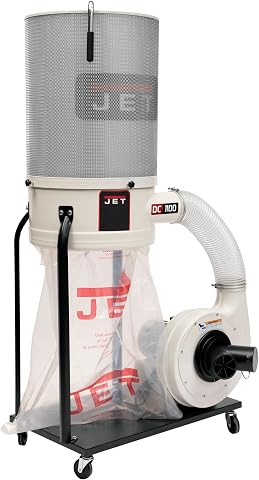
This indoor dust collector uses a Vortex Cone to separate wood chips before they reach the canister, helping maintain airflow and pack the collection bag efficiently. Its pleated 2-micron filter is cleaned by turning a handle, and it connects to woodworking machines through one 6-inch inlet or two 4-inch inlets.
Pros:
- Vortex Cone separates chips to help keep the filter clear and improve bag packing.
- Canister filter is cleaned with a handle without removing it.
- Connects to machines with one 6-inch inlet or two 4-inch inlets.
- Four swivel casters make it easier to move around a workshop.
Cons:
- Limited to indoor collection of wood dust and chips; not suitable for metal or liquids.
- Remote control is sold separately.
- Requires a 20A circuit when wired for 115V.
Best for: Woodworkers planning a central collection setup
Not ideal for: Shops that have not checked their machine connections
Bottom line: Match the collector’s verified connection details and installation needs to your machines and layout before buying.
Cyclone Separator
A cyclone separator sits between a tool and a collection unit to separate debris along the collection path. The listed pick is the Dustopper Pro Cyclone Dust Separator with High-Flow Elbows. It may be worth considering when you want a separator in your setup, but the product name alone does not establish compatibility with a particular collector, hose, or container. Check the product details against the equipment you already own before committing to a configuration. A frequent mistake is assuming that a separator will connect directly to every shop vacuum or dust collector, or that the included elbows will fit any hose. Compare the separator’s inlet and outlet dimensions with your system, and verify what container or other components are required. Think through where it will sit and whether the hose can reach without awkward bends or tension. Confirm the exact included parts and installation instructions, then check that the complete route from tool to separator to collector works for your intended use. Prioritize connection dimensions and container fit when reviewing the product details.What to look for:
- Compare inlet and outlet dimensions with your hoses and equipment.
- Verify compatibility with the intended collector or vacuum.
- Check whether a separate container is required and what fits.
- Confirm which elbows and other components are included.
- Plan a stable location and a practical hose route.
Dustopper Pro Cyclone Dust Separator with High-Flow Elbows

This low-profile cyclone separator captures dust before it reaches a shop vacuum, helping reduce filter and vacuum-bag use. It features an anti-static resin body, a preinstalled EPDM gasket for standard 5-gallon pails, and two high-flow sweep elbows designed to reduce airflow turbulence.
Pros:
- Designed to separate dust before it reaches the vacuum, helping reduce filter and bag use.
- Preinstalled gasket is designed to provide a leak-proof fit on standard 5-gallon pails.
- Includes two sweep elbows designed to reduce turbulence and flow restriction.
- Third-party testing reported strong separation performance with fine and coarse sawdust and drywall powder.
Cons:
- Requires a compatible standard 5-gallon pail.
- Listed compatibility specifies shop vacuums rated 5 HP or higher.
Best for: Shops adding a separator to a compatible collection path
Not ideal for: Buyers who have not verified container and hose dimensions
Bottom line: Confirm every connection and container requirement across the full tool-to-collector path.
Dust Extractor Hose
A dust extractor hose links a tool to a dust extractor or collection point, so its size and fittings can determine whether the pieces in your setup connect. Since no specific hose pick is listed, begin with the ports on your tools and collection equipment, then compare those measurements with the hose and adapter specifications. Account for the route the hose needs to follow and the reach required during normal work. The right choice depends on your equipment and layout rather than a generic label. A common mistake is buying by appearance or assuming that hoses with similar nominal sizes use interchangeable fittings. Check inner and outer dimensions where relevant, connector style, and any adapters required at each end. Consider whether the planned length gives enough reach without leaving excess hose to snag or interfere with the work area. Verify compatibility with the exact tool and extractor models, and review whether adapters are included or must be selected separately. Make a simple connection list before ordering so each end has a confirmed match and the hose route remains practical.What to look for:
- Measure both tool and extractor ports before selecting a hose.
- Match connector styles and verify adapter requirements.
- Choose a length suited to the planned route and working reach.
- Check compatibility with the exact equipment models.
- Confirm whether the needed adapters are included or separate.
Machine Dust Hood
A machine dust hood or collection port is the point where dust and chips enter the collection path, so its fit with the machine and hose matters. The listed product is the Table Saw, Towallmark 10 Inch 15A Multifunctional Saw with Stand & Pus. The product name identifies a saw, but it does not provide enough information to establish its dust-port dimensions or compatibility with a particular collector. Review the exact product details and instructions before treating it as a dust-collection solution. A common buying mistake is focusing on a machine’s general description while overlooking the actual port location, size, and access once the tool is set up. Check whether collection connects at the blade area, cabinet, or another point, and whether the selected hose or adapter can reach without obstructing operation. If you are buying for an existing saw, measure its port and compare it with the hood or connection specifications. If considering the listed saw, confirm its dust-collection provisions directly from the exact model documentation. Also account for stand placement and nearby clearance. Prioritize port dimensions, safe access, and a route that keeps the connection clear during use.What to look for:
- Verify the exact saw model’s dust-port location and dimensions.
- Check how the hood or port connects to the intended hose.
- Confirm adapters needed to join the machine and collection system.
- Plan placement so the hose does not obstruct operation or access.
- Review product documentation for included dust-collection components.
Table Saw, Towallmark 10 Inch 15A Multifunctional Saw with Stand & Push Stick, 9

The Towallmark portable table saw features a powerful 15 Amp motor delivering up to 5,000 RPM for cutting hardwoods. It offers adjustable blade height, 90° cross‑cut and 0–45° bevel angles, a dust‑collector port, and safety guards with a push stick.
Pros:
- High‑power 15 A motor provides fast cutting of hardwoods.
- Adjustable blade height and 0–45° bevel for versatile cuts.
- Dust collector port helps keep the workspace clean.
- Sturdy metal stand with triangle supports enhances stability.
Cons:
- Heavy at 57.1 lb, making transport less convenient.
- Bevel range limited to a maximum of 45°, which may restrict some angled cuts.
Best for: Buyers confirming machine-side collection compatibility
Not ideal for: Anyone relying on the product name for port details
Bottom line: Verify the exact machine’s dust-port specifications and connection path before selecting a hood or adapter.
Air Filtration Unit
An air filtration unit is a separate part of a dust-control plan from collection at the machine. The listed pick is the JET IAFS-2400 Industrial Air Filtration System, 2097 CFM, 3/4 HP. Its product name includes airflow and horsepower figures, but those details alone do not establish what coverage, placement, or installation will suit a particular shop. Consider where the unit can be positioned and how that location relates to the work area, then confirm the exact specifications in the product information. A common mistake is treating air filtration as a replacement for capturing dust at its source, or selecting a unit without considering room layout and mounting options. Check the manufacturer’s stated coverage guidance, installation requirements, and operating clearances for the exact model. Make sure the planned location works with the ceiling or support structure and leaves room for access. Consider how the unit’s placement relates to benches, machines, and circulation paths, without assuming a single position fits every shop. Verify the included controls and components from the product details. Use placement guidance and model-specific documentation to decide whether this unit fits your space.What to look for:
- Check manufacturer guidance for suitable room coverage.
- Verify mounting options and installation requirements.
- Measure clearances and access at the intended location.
- Review exact model details and included controls or components.
- Plan placement around the shop’s machines and work areas.
JET IAFS-2400 Industrial Air Filtration System, 2097 CFM, 3/4 HP

This workshop air filtration system uses a washable MERV 8 outer filter and a MERV 12 inner filter to capture dust, smoke, oil mist, and other particles. It has a remote control with three airflow speeds and a 1–9 hour timer, plus an optional slot for a charcoal filter to help reduce odors.
Pros:
- Washable outer filter paired with a MERV 12 inner filter
- Remote control includes a timer with automatic shutoff
- Three airflow speed modes
- Optional charcoal filter slot can help reduce odors
Cons:
- Optional charcoal filter is not included
- Weighs 120 pounds
Best for: Shops adding a separate air-filtration step
Not ideal for: Spaces without a suitable mounting or placement location
Bottom line: Use the exact model’s coverage and installation guidance to confirm it suits your shop layout.
Dust Collection Fittings
Fittings join the pieces of a dust-collection system, including machine ports, hoses, separators, and collectors. No specific product pick is provided, so start by listing each connection you need to make and measuring the relevant ports. The exact dimensions and connector styles determine which fittings or adapters will work. Avoid choosing from a broad label alone; compare the product specifications with the equipment at both ends of each connection. A common mistake is assembling a pile of adapters without mapping the whole route first. Each transition can affect fit and may make the setup harder to arrange, so identify the simplest compatible connection for each tool. Check whether a fitting is intended for the inside or outside of a hose or port, and verify its actual dimensions. Consider bends, branches, and access when planning where fittings will sit. Confirm material and construction details from the product listing if those matter for your installation. Keep a written connection map with measured dimensions and model names so you can check the full system before ordering.What to look for:
- Measure both sides of every connection before buying.
- Match the fitting’s inside or outside dimensions to the intended parts.
- Verify compatibility with exact hose, tool, separator, and collector models.
- Map branches and bends to keep the route practical.
- Check listing details for the fitting type and included pieces.
Start with the part that addresses your most immediate setup gap, then buy in an order that keeps compatibility clear: identify the machine connection, confirm the hose and fittings, and then choose or refine the collector and separator path. Consider air filtration as its own step, guided by the unit’s model-specific coverage and installation details.
You do not need to solve every connection at once. Measure carefully, verify each product against your tools and space, and build a setup that fits the way you work. A little planning around fit and routing can make the upgrade process easier to manage.
Black Friday Picks

Vitamix 5200 Blender with 64 oz. Container, Black
As an affiliate, we earn on qualifying purchases.