
If your Milwaukee power tool charger keeps blinking red, it indicates a problem that needs immediate attention. This guide provides clear, safe, and effective troubleshooting steps to resolve the issue and get your tools back to work quickly.

Get business pricing on tools and workshop supplies
- Business-only prices and quantity discounts
- Tax-exempt purchasing
- Multiple users, one account, clear invoices
Understanding the common causes behind red blinking lights on Milwaukee chargers can save you time and prevent unnecessary replacements. Let’s walk through the essential steps to diagnose and fix the problem efficiently.
Key Takeaways
| Identify the blinking pattern | A consistent red blink often indicates a charging issue, while a slow blink might mean a battery problem. |
| Check the battery condition | Damaged or old batteries are common causes of charging errors. |
| Inspect the charger and connections | Ensure the charger and power cord are free of damage and properly connected. |
| Test with different batteries | Using a known good battery helps determine if the issue is with the battery or charger. |
| Follow safety precautions | Always unplug the charger before inspecting or handling internal components. |
Understanding the Red Blinking Light Pattern
The first step is to observe the blinking pattern on your Milwaukee charger. Typically, a steady red light indicates that the charger is charging normally, while a blinking red light signals a problem. A rapid blink might mean the battery is incompatible or faulty, whereas a slow, intermittent blink could point to overheating or poor contact.
Consult your specific charger model’s manual for precise blinking patterns and their meanings, as these can vary slightly among models. Recognizing the pattern helps you accurately diagnose the root cause before proceeding with repairs or replacements.
Inspecting and Testing Your Batteries
- Remove the battery from the charger and visually inspect for any damage, swelling, or corrosion on the terminals.
- If available, test the battery with a different, known working charger to see if it charges normally.
- Use a multimeter to check the voltage of the battery. For example, a healthy M18 battery should read around 18V. If significantly lower, the battery may be defective or drained beyond recovery.
- If the battery is old or damaged, replacing it with a compatible Milwaukee battery (like the Milwaukee 48-11-1850R 5.0 Ah or the M18 REDLITHIUM XC6.0) can resolve charging issues.
Always handle batteries carefully, and avoid attempting to open or repair them yourself, as this can be dangerous.
Checking the Charger and Power Supply
- Ensure the charger is plugged into a working power outlet. Test the outlet with another device to confirm it supplies power.
- Inspect the charger’s power cord for cuts, frays, or damage. If damaged, replace the cord or charger unit.
- Clean the charging contacts on both the charger and battery with a dry cloth to remove dirt or debris that could interfere with contact.
- Try charging a different compatible battery on the same charger. If it charges successfully, the problem is likely with your original battery.
Sometimes, environmental factors like extreme cold or heat can impact charging performance. Store batteries at room temperature for optimal results.
Resetting and Troubleshooting Your Charger
Many Milwaukee chargers include a reset function or require a simple reset process:
- Unplug the charger from the power outlet and wait for at least 30 seconds to allow internal circuits to reset.
- Reconnect the charger and insert a battery to see if the blinking red light persists.
- If your charger has a reset button, press it according to the manual’s instructions.
If the blinking continues, consider testing with a different charger compatible with your Milwaukee batteries. If that charger works, your original charger may need professional repair or replacement.
When to Replace or Seek Professional Repair
If all troubleshooting steps fail to resolve the red blinking issue, it may be time to replace the charger or battery. If your charger is still under warranty, contact Milwaukee customer service for repair or replacement options.
For batteries, consider replacing old or damaged units with high-quality Milwaukee batteries like the Milwaukee 48-11-1850R 5.0 Ah or the M18 REDLITHIUM XC6.0 for extended runtime and reliable power.
Always follow safety guidelines when handling power tools and chargers. Avoid attempting internal repairs yourself, as this can pose safety risks.
The Products in This Guide
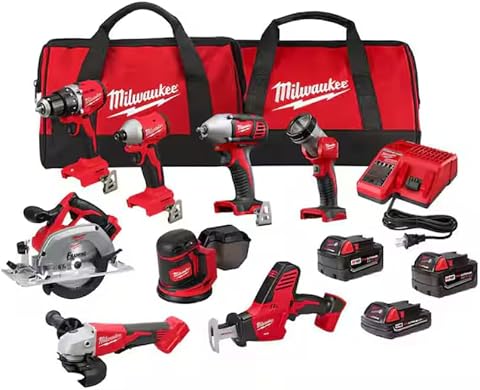
Milwaukee M18 18V Cordless Power Tool Combo Kit
- ✔ Voltage: 18V
- ✔ Number of Batteries: 3
- ✔ Tools Count: 8
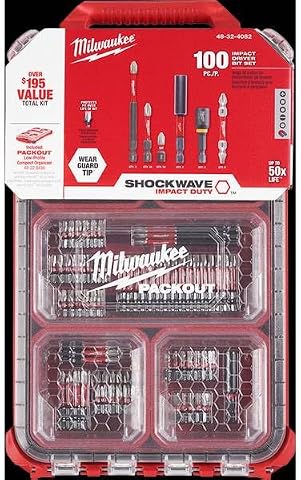
Milwaukee Shockwave 100pcs Impact Driver Bit Set Packout
- ✔ Number of Bits: 100
- ✔ Case Type: Packout
- ✔ Material: Impact steel
Milwaukee M18 18V Cordless Power Tool Combo Kit
The Milwaukee M18 18V Cordless Power Tool Combo Kit includes everything needed for professional and DIY projects, with reliable batteries and a charger that benefits from proper maintenance.
Pros:
- Complete 8-tool set for versatility
- Includes 3 batteries for extended work
- Durable construction for tough jobs
- Two heavy-duty tool bags for portability
Cons:
- Heavy weight for prolonged use
- Additional batteries may be needed for high-demand tasks
Best for: Construction, remodeling, maintenance tasks requiring multiple tools
Not ideal for: Light-duty or occasional use where fewer tools suffice
Bottom line: This comprehensive kit offers durability and versatility for demanding jobs.
Milwaukee Shockwave 100pcs Impact Driver Bit Set Packout
Enhance your Milwaukee toolkit with this 100-piece Impact Driver Bit Set, packed in a durable Packout case for easy transport and organization.
Pros:
- Wide variety of bits for different tasks
- Durable impact-rated bits
- Packout case for portability
- Great value for frequent users
Cons:
- Bits may wear out with heavy use
- Limited to impact driver applications
Best for: Professional and DIY projects requiring multiple bit sizes
Not ideal for: Light-duty or occasional use where fewer bits suffice
Bottom line: A comprehensive set to boost efficiency on demanding projects.
Frequently Asked Questions
What does a blinking red light on my Milwaukee charger mean?
It typically indicates a problem such as a faulty battery, poor contact, or charger malfunction. Refer to your manual for specific patterns.
Can I fix a blinking red light myself?
Yes, by inspecting the battery and charger, cleaning contacts, and testing with different batteries. However, internal repairs should be done by professionals.
How do I reset my Milwaukee charger?
Unplug the charger, wait 30 seconds, then reconnect and test. Some models may have a reset button—refer to your manual.
When should I replace my Milwaukee battery?
When it no longer holds a charge, shows physical damage, or has internal faults. Upgrading to higher capacity batteries can improve performance.
Is it safe to open the charger or battery?
No, opening internal components can be dangerous. Always seek professional repair or replacement.
Getting Your Milwaukee Charger Back in Action
Dealing with a blinking red light on your Milwaukee charger can be frustrating, but with a systematic approach, most issues are fixable. Start by inspecting the batteries and charger connections, and test with known good components. If problems persist, professional repair or replacement might be necessary. Regular maintenance and using quality batteries like the Milwaukee 48-11-1850R 5.0 Ah or the M18 REDLITHIUM XC6.0 can extend your tools’ lifespan and ensure reliable performance.
By following these steps and safety tips, you can keep your Milwaukee power tools functioning smoothly and avoid costly downtime on your projects.
Affiliate disclosure: As an Amazon Associate we earn from qualifying purchases. Prices and availability are accurate as of the time of publishing.
Halloween Picks
halloween
As an affiliate, we earn on qualifying purchases.