
TL;DR
A Family Handyman reviewer tested the Anker Solix Smart Generator 5500 for just over a month, using gasoline and propane and connecting it to a Solix E10 home battery system. The reviewer reported easy setup and app-based operation, but has not tested natural gas and cautioned that the full backup system carries substantial costs.
Family Handyman reviewer Paul Rankin has published a hands-on report on the Anker Solix Smart Generator 5500, describing more than a month of testing with gasoline and propane and a connection to an Anker Solix E10 home battery system. Rankin reported that setup and app controls were straightforward, while noting the generator’s noise and the cost of the larger battery-and-backup installation; his headline’s promise that he will “never lose power again” is a personal conclusion, not a guarantee of uninterrupted electricity.

Get business pricing on tools and workshop supplies
- Business-only prices and quantity discounts
- Tax-exempt purchasing
- Multiple users, one account, clear invoices
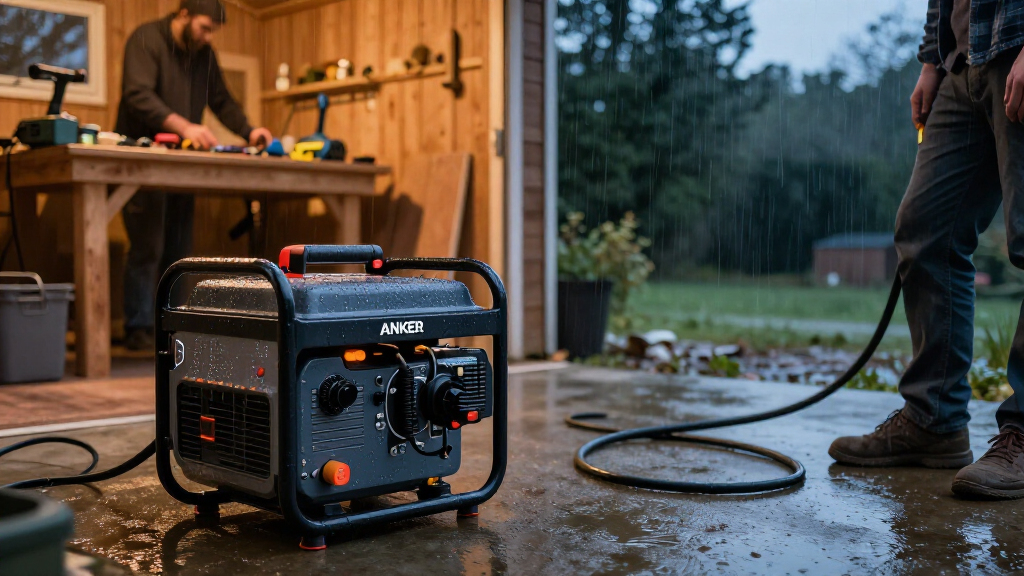
The 224cc, four-stroke generator can run on gasoline, propane or natural gas. Anker lists up to 4,500 watts of DC output on gasoline or propane and up to 4,000 watts on natural gas. Its AC output is rated at up to 3,600 watts across the three fuels, through a NEMA TT-30R outlet and a NEMA 5-20R outlet. The review describes it as usable on its own as well as with compatible Anker equipment.
Rankin tested gasoline and propane, manual and app-based starting, operating modes, portability, noise and the generator’s connection to the E10 system. He said initial setup took about 20 minutes, including connecting the startup battery and adding engine oil. During testing, he reported no starting problems, overloads, connection failures or app glitches. He also observed DC charging output reaching around 4.5 kilowatts, in line with the advertised maximum for gasoline or propane.
In Rankin’s home, the generator charged the E10 battery system; the batteries, rather than the generator directly, supplied power to household loads. His setup also included rooftop solar, two E10 power modules and three battery expansion modules. He said the battery equipment cost around $14,000, with professional installation adding approximately $4,500. Those figures describe his installation, not the generator’s price or a standard system cost.
How the Generator Fits Home Backup
The review’s main finding is about how the generator works with a compatible battery system. Its direct DC connection can send power into an E10 without first converting the generator’s output to AC and then back to DC, according to the report. That gives the generator a role as a charging source when solar production is insufficient, including at night, while the batteries handle the home’s electrical demand.
That arrangement may interest households considering backup for extended outages, but it also involves separate costs and installation decisions. Rankin’s system depended on rooftop solar, the E10 equipment and professional installation. His test shows how those components worked together in one home; it does not establish that every household will get the same results or that the generator alone can run an entire house.
Popular right now

KitchenAid Classic Series 4.5-Quart Tilt-Head Stand Mixer, Onyx Black

Ninja Foodi 8-Qt DualZone 6-in-1 Air Fryer, Grey (DZ201)

Breville BES870XL Barista Express Espresso Machine, Brushed Stainless Steel
As an affiliate, we earn on qualifying purchases.
What Rankin Tested at Home
Rankin conducted the review at his Florida home, where hurricanes and severe storms can cause outages lasting hours or days. He already had rooftop solar and an Anker Solix E10 whole-home battery system, so the generator was tested both on its own and as part of that existing setup.
The testing lasted just over a month, but the longest continuous generator run described in the source was about two hours. Rankin used gasoline and propane and tried both app-based and physical starting. He had not tested natural gas: connecting it to the home’s gas supply would require professional installation, which he said he planned to pursue later.
““The biggest surprise was how easy Anker made practically everything about using a gas-powered generator.””
— Paul Rankin, Family Handyman reviewer
Natural Gas and Longer Runs Untested
The review does not establish how the generator performs on natural gas, because Rankin had not installed the required connection to his home’s gas supply. The longest continuous test reported was about two hours, so the supplied account does not show performance over a full night or a multi-day outage. It also does not provide a measured noise level, fuel-consumption figures, or a comparison with other generators.
The article’s headline says “I’ll Never Lose Power Again,” but the testing describes one home’s backup arrangement and does not prove that outages can be eliminated. Actual coverage would depend on the installed equipment, available fuel, battery capacity, household demand, solar conditions and system setup.
A Gas Connection Is Planned
Rankin said he plans to add a professionally installed natural-gas connection and test the generator on that fuel. The supplied report does not give a date for that work or report its results. Further testing could clarify how the unit performs on natural gas and how it operates during longer runs; for now, the reported findings cover gasoline and propane use, with the longest continuous test lasting about two hours.
Key Questions
Which fuels did the reviewer test?
Rankin tested the generator with gasoline and propane. He said he had not yet tested natural gas because a connection to the home supply would require professional installation.
Can the generator power a whole house directly?
In Rankin’s setup, the generator charged the Solix E10 battery system, and the batteries supplied electricity to household loads. The review does not describe the generator directly powering every appliance.
What output did the review report?
The generator is rated for up to 3,600 watts of AC output. Anker lists up to 4,500 watts of DC output on gasoline or propane and up to 4,000 watts on natural gas; Rankin reported seeing around 4.5 kilowatts during DC charging.
How much did the reviewer’s home backup system cost?
Rankin said his battery equipment cost around $14,000 and professional installation added approximately $4,500. Those are costs for his E10-based installation, not a quoted price for the generator or a standard package.
Source: rss