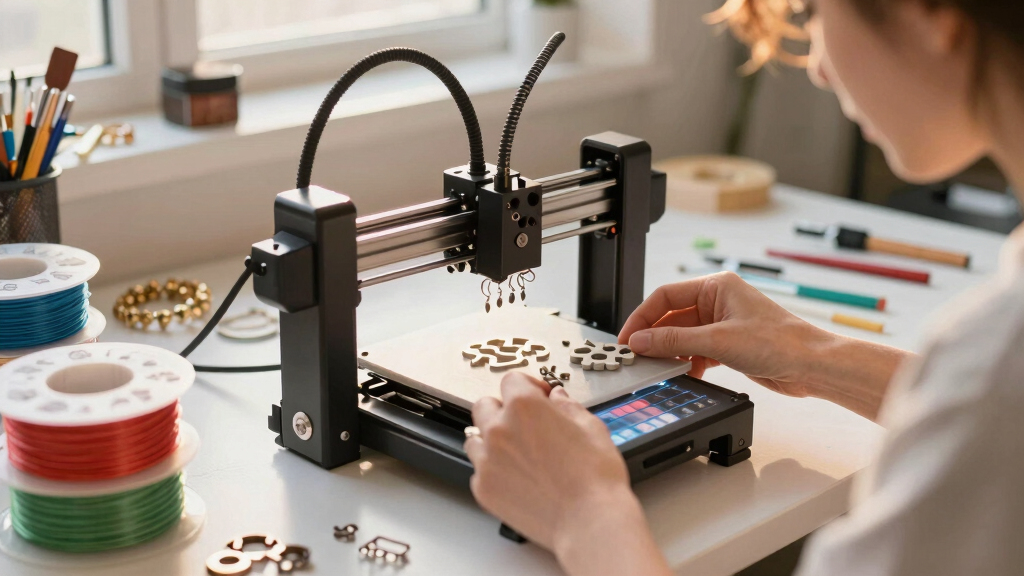
Finding the best 3D printer for earring cutters involves balancing precision, ease of use, and material compatibility. The Creality K2 Plus Combo stands out for its reliable performance and large build volume, making it ideal for detailed jewelry tools. The FLASHFORGE Adventurer 5M offers high-speed printing and auto-leveling, perfect for fast production. Meanwhile, the Entina TINA2S is a solid choice for beginners thanks to its user-friendly interface and WiFi connectivity. All options come with tradeoffs: higher speed can sometimes sacrifice detail, while budget models may lack advanced features. Continue reading for a full comparison to find your perfect match.
Key Takeaways
- High-speed printers like the FLASHFORGE AD5X excel at quick turnaround but may compromise on intricate detail needed for fine jewelry tools.
- Auto-leveling features significantly reduce setup time, making models like the Entina TINA2S ideal for new users without prior experience.
- Build volume varies; larger sizes like the Creality K2 Plus accommodate bigger or multiple earring cutters, but often come at a higher cost.
- Material compatibility is key—printers with higher temperature nozzles (e.g., 300°C) support diverse filaments like PETG and ABS, expanding design options.
- Price doesn’t always correlate with quality—budget-friendly models can deliver surprisingly precise results, but often lack advanced features.




More Details on Our Top Picks
Creality K2 Plus Combo 3D Printer
This model stands out for its support of up to four CFS units, enabling vibrant multi-color prints that are ideal for detailed earrings. Its high-speed capability of 600mm/s lets you mass-produce or iterate quickly, making it a strong choice over the simpler Entina TINA2S, which lacks multi-color support. The dual AI cameras and heated chamber provide monitoring and material versatility, but this comes with added complexity in setup and weight (27.5 lbs), requiring a sturdy, stable surface. Compared with the FLASHFORGE AD5X, it offers larger volume capacity but less focus on speed and multi-color automation. This pick makes the most sense for experienced hobbyists or small-scale jewelers who need vibrant, multi-material earrings and are comfortable with a more involved setup process.
Pros:- Supports up to four CFS units for vibrant multi-color printing
- High-speed printing at 600mm/s for rapid prototyping
- Dual AI cameras enable real-time error detection and monitoring
- Heated chamber allows advanced material use like PLA-CF and ASA
Cons:- Heavy frame (27.5 lbs) demands a sturdy, stable location
- Complex setup, especially with multiple CFS units, may intimidate new users
Best for: Designers and jewelers needing large, multi-color, detailed earrings with multi-material options.
Not ideal for: Beginners or small craft hobbyists with limited space and less experience with complex multi-color 3D printing.
- Product Dimensions:19.49 x 36.06 x 20.28 inches
- Item Weight:27.5 pounds
- Build Volume:350 x 350 x 350mm
- Support Multi-Color:Yes, up to four CFS units
- Max Speed:600mm/s
- Heated Chamber:Yes
Bottom line: A powerful choice for experienced users who need large, vibrant multi-material earrings and are willing to handle setup complexity.
FLASHFORGE Adventurer 5M 3D Printer
The Adventurer 5M makes the list for its combination of ultra-fast speeds—up to 600mm/s—and automatic bed leveling, simplifying the process for those who want quick results without sacrificing quality. Compared with the Creality K2 Plus Combo, it offers less volume but excels in speed and ease of use, especially for rapid earrings prototyping. Its direct extruder with a 280°C max temperature supports a wide range of filament types, making it suitable for detailed and durable jewelry. The wireless connectivity and remote monitoring via the Flash Maker app provide added convenience, but its build volume (220x220x220mm) limits larger or more complex designs. This printer is best suited for jewelers or hobbyists who prioritize speed and flexibility over large-scale production or multi-material complexity.
Pros:- Extremely fast printing speeds of up to 600mm/s
- Automatic bed leveling for hassle-free setup
- Wide filament compatibility including high-temperature materials
- Wireless remote monitoring and control via mobile app
Cons:- Limited build volume (220x220x220mm), restricting larger earrings
- Less focus on multi-color or multi-material printing
Best for: Jewelry designers seeking rapid turnaround and versatile filament compatibility.
Not ideal for: Users needing large build volumes or multi-color, multi-material output for complex earrings.
- Build Volume:220 x 220 x 220mm
- Max Speed:600mm/s
- Max Extruder Temperature:280°C
- Connectivity:WiFi, Mobile App
- Support Auto Leveling:Yes
Bottom line: Ideal for fast, flexible jewelry prototyping when large volume is not a priority.
Entina TINA2S WiFi 3D Printer
The Entina TINA2S is a compact, fully assembled WiFi-enabled printer that emphasizes ease of use with auto leveling and access to over 1,000 cloud models, making it perfect for newcomers and educational settings. Its 0.04mm high precision output can produce fine details suitable for small earrings, but the limited build volume (3.9 x 4.7 x 3.9 inches) restricts larger or more complex designs. Compared with the ELEGOO Centauri Carbon, it sacrifices speed and material breadth for simplicity and convenience, which is ideal for beginners but less so for experienced jewelers seeking advanced features or larger prints. Its low noise operation and straightforward interface make it accessible, though the small size may not satisfy professional or large-scale jewelry projects.
Pros:- Fully assembled and easy to operate, no setup required
- Auto leveling reduces manual calibration
- Access to extensive cloud library of models
- Low noise operation suitable for classroom or home use
Cons:- Limited build volume restricts larger earrings
- Lacks multi-color or multi-material support
Best for: Beginners, students, or families exploring jewelry design for small earrings or craft projects.
Not ideal for: Experienced jewelers or professionals needing large, multi-material, or high-detail production runs.
- Print Size:3.9 x 4.7 x 3.9 inches
- Support WiFi:Yes
- Auto Leveling:Yes
- High Precision:0.04 mm
- Weight:9.08 pounds
Bottom line: A straightforward, beginner-friendly printer suitable for small earrings and educational purposes.
ELEGOO Centauri Carbon 3D Printer
The ELEGOO Centauri Carbon excels with its fully assembled, pre-calibrated design, supporting fast speeds—up to 500mm/s—and high-temperature materials with a 320°C nozzle, making it ideal for precise earrings requiring durability and fine detail. Its die-cast aluminum frame ensures stability even at high speeds, outperforming less rigid printers like the Entina TINA2S in consistency. The 256x256x256mm build volume strikes a balance between size and precision, suited for detailed jewelry pieces. The onboard camera and intuitive touchscreen enhance user experience, but the slightly higher price and advanced features may be overkill for hobbyists focused solely on simple designs. This pick makes the most sense for experienced jewelers or tech-savvy hobbyists looking for speed and accuracy in a professional-grade printer.
Pros:- Supports high-speed printing up to 500mm/s
- Pre-calibrated and ready to use out of the box
- Enclosed chamber with camera for real-time monitoring
- High-temp hotend supports advanced filaments like carbon fiber
Cons:- Higher price point compared to entry-level models
- Build volume is modest for large or complex earrings
Best for: Jewelry professionals and advanced hobbyists needing fast, precise, multi-material earrings production.
Not ideal for: Beginners or those with limited space or budget seeking simple, entry-level printers.
- Build Volume:256 x 256 x 256mm
- Max Speed:500mm/s
- Max Nozzle Temperature:320°C
- Camera:Built-in
- Frame:Die-cast aluminum
Bottom line: A top choice for professionals and experienced hobbyists demanding speed, precision, and multi-material capability.
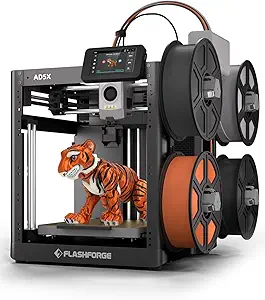
FLASHFORGE AD5X Multi-Color 3D Printer
The FLASHFORGE AD5X is designed for multi-color and multi-filament projects, supporting up to 4 colors with its Intelligent Filament System, making it a versatile choice for jewelry that demands vibrant, multi-hued earrings. Its high speed—up to 600mm/s—coupled with auto filament loading and unloading reduces downtime for small batch production. Compared with the Creality K2 Plus Combo, the AD5X emphasizes automation and multi-material support, though it offers a slightly smaller build volume (220x220x220mm). Its 300°C hotend enables use of advanced filaments like carbon fiber-reinforced PLA and PETG. The 4.3-inch touchscreen and remote management features add user-friendly controls, but its somewhat lower user ratings suggest some users experience setup or reliability issues. It’s best suited for jewelers or small factories aiming for quick, multi-color earrings with minimal manual intervention.
Pros:- Supports four filament colors simultaneously
- High-speed printing up to 600mm/s
- Auto filament loading/unloading reduces manual work
- Supports advanced filaments like carbon fiber and PETG
Cons:- Moderate build volume limits larger designs
- Mixed user reviews on reliability and setup complexity
Best for: Jewelry producers requiring multi-color, multi-material earrings in small batches with automation features.
Not ideal for: Hobbyists or small-scale crafters who prioritize larger build sizes or single-material projects.
- Build Volume:220 x 220 x 220mm
- Max Speed:600mm/s
- Support Multi-Color:Yes, 4-color
- Filament Support:PLA-CF, PETG-CF, etc.
- Touchscreen:Yes
Bottom line: A strong choice for multi-color jewelry manufacturing where speed and automation are key priorities.
Creality K2 SE 3D Printer, Support Multicolor Printing Needs CFS, 500mm/s High-Speed Printing, Auto Leveling, Vibration Control, Compact Desktop Upgrate 3D Printer, Print Size 220x215x245mm
The Creality K2 SE stands out for its combination of user-friendly features and rapid printing speeds, making it ideal for newcomers and those needing quick turnarounds. Unlike the FLASHFORGE AD5X, which emphasizes multi-material capabilities and remote monitoring, the K2 SE focuses on straightforward operation with auto-calibration, reducing setup time and frustration. Its core XY structure and vibration control deliver reliable quality at high speeds, though this may come at the expense of slightly less detailed prints compared to more precision-oriented models. The pre-assembled design and auto-leveling make it accessible for users with minimal experience, but its high-speed printing can sometimes compromise fine detail or surface finish, especially on complex designs. Overall, the K2 SE offers a balanced blend of speed, stability, and ease of use, ideal for those who prioritize quick, reliable prints without extensive tinkering.
Pros:- Fast printing speeds up to 600mm/s for quick prototypes
- Auto-calibration simplifies setup for beginners
- Pre-assembled and ready to use right out of the box
- Vibration control ensures stable print quality
Cons:- Limited in multi-color capabilities, not matching multi-material printers like the FLASHFORGE AD5X
- Speed-focused design may reduce fine detail on complex models
Best for: Beginners and hobbyists who want fast, reliable prints with minimal setup.
Not ideal for: Advanced users needing ultra-fine detail or multi-material multi-color printing, as it lacks multi-color support and advanced features.
- Build Volume:220x215x245mm
- Max Speed:500mm/s
- Auto Leveling:Yes
- Hotend Temperature:300°C
- Print Bed Type:Flexible steel
- Connectivity:USB/SD
Bottom line: This printer suits beginners and hobbyists seeking speed and simplicity over ultra-fine detail.
FLASHFORGE AD5X Multi-Color 3D Printer, CoreXY 600mm/s High-Speed, 1-Click Auto Leveling, 300°C Direct Drive Extruder, 220x220x220mm Build Volume, Ideal for Precision and Efficiency
The FLASHFORGE AD5X excels at vibrant, multi-color printing thanks to its support for up to four colors simultaneously, making it perfect for complex, detailed designs like jewelry or earrings. Its auto-leveling and remote control features offer a level of convenience that surpasses the more basic K2 SE, especially for users who want hands-off operation. However, compared with the Creality K2 SE, which emphasizes speed and ease of setup, the AD5X is more geared toward precision and color fidelity, though at a higher price point. Its support for multiple nozzle sizes from 0.25mm to 0.8mm provides versatility but requires more user management and calibration. The tradeoff is that this model demands a bit more technical familiarity to maximize its creative potential, especially with multi-material filaments.
Pros:- Supports up to 4 colors simultaneously for complex designs
- Auto-leveling and remote monitoring for ease of use
- Supports multiple nozzle sizes for versatility
- High-speed printing up to 600mm/s
Cons:- Higher cost and complexity compared to single-color printers
- Requires more calibration and management for multi-color printing
Best for: Designers and hobbyists focused on multi-color, detailed earrings and jewelry pieces.
Not ideal for: Beginners or those prioritizing high speed over color complexity, as setup and multi-material management can be complex.
- Build Volume:220x220x220mm
- Max Speed:600mm/s
- Number of Colors:Up to 4
- Nozzle Sizes:0.25mm to 0.8mm
- Auto Leveling:Yes
- Connectivity:Wi-Fi, USB
Bottom line: Ideal for creative professionals and hobbyists who need vibrant, detailed multi-color earrings with reliable automation.
Creality K2 Combo (A) 3D Printer with Multicolor Printing and Smart Features
The Creality K2 Combo (A) offers impressive multicolor capabilities with up to 16 colors using four CFS units, making it a strong choice for detailed earrings requiring multiple hues and intricate color blends. Its pre-assembled design and RFID filament detection streamline setup, while AI camera monitoring enables remote supervision, a feature absent in simpler models like the K2 SE. The direct drive extruder supports advanced filaments including carbon fiber-filled materials, expanding creative options. However, this sophistication comes with a higher price and increased complexity, which might be overwhelming for beginners. The multiple components and smart features are best utilized by users comfortable with technical adjustments, not those seeking a straightforward plug-and-play printer.
Pros:- Supports up to 16 colors with four CFS units
- Pre-assembled and includes smart RFID and AI camera features
- High-speed up to 600mm/s with precise step-servo motors
- Compatible with advanced filaments like carbon fiber
Cons:- Higher price and more complex setup
- Overkill for simple or occasional printing needs
Best for: Artists and experienced hobbyists who need multi-color precision and remote control for detailed earrings.
Not ideal for: Beginners or casual users who prefer a straightforward, less expensive printer and don’t need extensive color options.
- Build Volume:260x260x260mm
- Max Speed:600mm/s
- Colors Supported:Up to 16
- Supported Materials:PLA, PETG, ABS, Carbon-fiber filaments
- Connectivity:RFID, Wi-Fi, USB
- Nozzle Compatibility:Quick-swap
Bottom line: Best suited for advanced users who require multi-color, multi-material capabilities with smart monitoring features.
FLASHFORGE AD5M Pro 3D Printer 600mm/s High Speed & Precision, Full-Auto Calibration with 0.4&0.6mm Nozzle Bundle, CoreXY Structure & Auxiliary Chamber Cooling, ≤50 dB Quite Printing Camera Printers
The FLASHFORGE AD5M Pro combines high-speed performance with quiet operation and advanced multi-material support, making it a compelling choice for detailed jewelry like earrings. Its auto-leveling and chamber cooling system provide consistent quality, while the full-enclosure design offers safety and minimal noise—features appealing to home-based studios. Compared to the Creality K2 SE, which emphasizes speed and simplicity, the AD5M Pro offers more precision and multi-material flexibility, but at a higher complexity level. Its broad nozzle options and multi-filament compatibility expand creative possibilities, though managing multiple filaments and settings may challenge less experienced users. The quiet operation and remote monitoring make it suitable for continuous workflow in shared spaces.
Pros:- High-speed 600mm/s printing with quiet operation
- Full auto-calibration and chamber cooling for consistent results
- Supports multiple filaments and nozzle sizes (0.4/0.6mm)
- Enclosed design for safety and minimal noise
Cons:- Higher price point and more complex operation
- Requires understanding multi-material management for best results
Best for: Jewelry makers and hobbyists needing high precision and multi-material flexibility in a quiet, safe environment.
Not ideal for: Beginners or casual users who prioritize simplicity over advanced multi-material features and multi-nozzle options.
- Build Volume:220x220x220mm
- Max Speed:600mm/s
- Nozzle Sizes:0.4 & 0.6mm
- Filament Compatibility:Multiple
- Auto Leveling:Yes
- Noise Level:≤50 dB
Bottom line: Well-suited for experienced users who need high speed, multi-material flexibility, and quiet operation for detailed earrings.
3D Printer for Kids and Beginners,Geeetech Mini 3D Printers with Auto Leveling,High Speed and Fully Open Source,Fully Assembled Direct Drive Extruder,for Home and School,Print Area 3.94×4.33×3.94 in
The Geeetech Mini 3D Printer is tailored for newcomers and young creators, emphasizing simplicity and safety. Its fully assembled design and auto-leveling system make it accessible for users with no prior experience, and its small print area is perfect for earrings or small jewelry pieces. Compared with larger, more feature-rich printers like the FLASHFORGE AD5X, this model sacrifices volume and speed for ease of use and affordability. Its open-source firmware encourages learning and customization, but this also means it may lack some of the advanced safety or automation features that more mature models offer. The dual-drive extruder improves print accuracy for small details, but the limited build volume may restrict larger or multiple-piece projects.
Pros:- Fully assembled and easy to operate right out of the box
- Auto-leveling simplifies setup for beginners
- Compact size ideal for small jewelry projects like earrings
- Open-source firmware for customization
Cons:- Limited build volume restricts larger or multiple items
- Lower speed and fewer advanced features compared to higher-end models
Best for: Kids, beginners, and educators seeking a safe, easy-to-use 3D printer for small jewelry and craft projects.
Not ideal for: Advanced hobbyists or professionals needing large build volumes or multi-color, multi-material capabilities.
- Build Volume:3.94×4.33×3.94 in
- Print Speed:Up to 250mm/s
- Auto Leveling:Yes
- Extruder Type:Dual Drive
- Supported Filaments:PLA, TPU, ABS
- Connectivity:SD Card, USB
Bottom line: Perfect for absolute beginners and young makers wanting a simple, safe option for small jewelry projects.
52-in-One 3D Printer Maintenance Kit with Deburring Tool, Nozzles, Scrapers & Storage Bag
This extensive 52-piece kit stands out for those who want a complete arsenal for maintaining and fine-tuning their 3D printers, including options for both FDM and SLA models. It surpasses basic toolsets by offering high-quality deburring blades, precision knives, and nozzle cutters, making it ideal for detailed post-processing of earrings. Compared with simpler cleaning kits, this set provides a broader range of tools, but that also means a steep learning curve for beginners who might find the number of options overwhelming. The included durable storage bag helps keep everything organized, which is essential for frequent maintenance. However, for casual hobbyists or those with minimal repair needs, this kit might be more than necessary and could be seen as clutter. Overall, this pick makes the most sense for dedicated jewelers or serious hobbyists who regularly service their printers and require a versatile, all-in-one toolkit.
Pros:- Extensive set covering all maintenance and post-processing needs
- High-quality blades and tools with durable materials
- Portable storage bag for organization and transport
- Includes both FDM and SLA compatible tools
Cons:- Overkill for infrequent or casual users
- Steep learning curve for proper tool use and maintenance
- Some tools may require experience to avoid damage
Best for: Professional jewelry makers or dedicated hobbyists needing comprehensive maintenance tools
Not ideal for: Casual users or beginners who only occasionally need basic cleaning and minor repairs
- Pieces:52
- Warranty:1-Year
- Deburring Tool Blades:5 BS1010
- Precision Knife Blades:5 SK5 Steel
- PTFE Tube Cutter Material:Stainless Steel
- Suitable for:FDM and SLA printers
Bottom line: This maintenance kit is best suited for experienced users who prioritize comprehensive tool coverage for detailed jewelry post-processing.
How We Picked
I evaluated each 3D printer based on core factors that matter most for creating earring cutters, such as precision, build volume, ease of use, and material capabilities. I prioritized models with auto-leveling, reliable extruders, and user-friendly interfaces to ensure they suit both experienced and beginner jewelry makers. Cost-effectiveness was also a key consideration, balancing features against price. The ranking reflects a combination of performance, versatility, and value, with higher-rated models offering a better blend of speed and detail for jewelry applications.Factors to Consider When Choosing Best 3d Printer For Earring Cutters
Choosing the right 3D printer for earring cutters requires considering several critical factors that influence quality, usability, and overall value. Beyond features, understanding broader tradeoffs helps prevent costly mistakes and ensures the printer aligns with your specific needs—whether you’re a hobbyist, small business owner, or professional jeweler. Here are key considerations to guide your decision.Print Precision and Resolution
For earring cutters, precision is vital. Look for printers capable of at least 50-micron resolution to capture fine details essential for jewelry tools. Higher resolution ensures smoother edges and more accurate cuts, reducing post-processing work. Keep in mind that achieving high detail may slow printing speeds, so balance resolution with your productivity needs. Also, consider the stability of the frame and extruder quality, as these influence consistent accuracy over time.
Build Volume and Size
The size of your printer determines the maximum dimensions of your earring cutters. Larger build volumes give flexibility to print multiple items or bigger designs in one go, which can save time and streamline production. However, bigger machines tend to cost more and may require more space. For small-scale or detailed work, a compact printer can be sufficient, but ensure it can handle the size of your typical projects without sacrificing detail or quality.
Material Compatibility
Jewelry tools often benefit from a variety of filament options, including ABS, PETG, or specialty resins. Printers with higher nozzle temperatures (above 280°C) expand your material choices, enabling stronger, more durable cutters. Also, consider whether the printer supports resin-based printing for ultra-fine details, which can be a game changer for intricate designs. Remember, higher temperature and resin printing often require more maintenance and safety precautions, so weigh these factors against your skill level.
Ease of Use and Maintenance
If you’re new to 3D printing or jewelry making, features like auto-leveling, touchscreen interfaces, and cloud connectivity can dramatically reduce setup time and errors. Frequent maintenance tasks, such as nozzle cleaning or bed leveling, should be straightforward to perform. Investing in a model with good community support and accessible tutorials also helps prevent frustration and accelerates your learning curve. Remember, more complex features often come with higher costs and a steeper learning curve.
Speed and Efficiency
Speed is tempting, especially if you produce multiple cutters regularly. Printers with high maximum speeds (600mm/s or more) can significantly cut down production time. However, extremely high speeds may lead to a decrease in detail or print quality, especially with delicate jewelry designs. Striking the right balance between speed and detail is essential; look for models that offer adjustable speeds and good stability during fast printing for the best results.
Frequently Asked Questions
Can I print with flexible filaments for earring cutters?
Yes, certain 3D printers support flexible filaments like TPU or TPE, which can be useful for creating soft, durable parts. However, printing with flexible materials often requires specific extruder setups and careful calibration to avoid issues like stringing or poor layer adhesion. For jewelry tools, the ability to work with a variety of materials expands design possibilities, but ensure your chosen model explicitly supports these filaments and has a suitable extruder.
Is resin printing better for making earring cutters?
Resin printers excel at producing ultra-fine details and smooth surfaces, which is beneficial for intricate jewelry components. However, resin printing involves handling chemicals and post-processing steps like curing and cleaning, which may be challenging for beginners. While resin can deliver highly precise cutters, consider your comfort with these additional steps and your workspace setup. For larger or more durable cutters, filament-based printers might be more practical.
What is the importance of auto-leveling for jewelry tool production?
Auto-leveling simplifies bed calibration, ensuring consistent layer adhesion and dimensional accuracy across multiple prints. For delicate jewelry cutters, this consistency is critical to maintain precise dimensions and clean edges. Without auto-leveling, manual adjustments can lead to uneven surfaces or failed prints, especially if you’re inexperienced. Investing in a model with this feature reduces errors and saves time during setup, making it especially valuable for frequent production.
Should I prioritize speed over detail when choosing a printer?
While faster printers can increase productivity, sacrificing too much detail can undermine the quality needed for precise earring cutters. The key is finding a balance—many high-speed models offer adjustable speeds, allowing you to optimize for detail or speed depending on the project. For detailed jewelry tools, prioritizing resolution and stability over raw speed usually results in better final products. Consider your typical project size and quality requirements before making this tradeoff.
How important is community support and tutorials for new users?
Community support and accessible tutorials are invaluable, especially if you’re new to 3D printing. A strong user community offers troubleshooting advice, modifications, and shared experiences that can accelerate your learning curve. Manufacturers with active forums and online resources make it easier to resolve issues and improve print quality. For beginners, choosing a model with ample support reduces frustration and helps you produce better, more consistent earring cutters from the start.