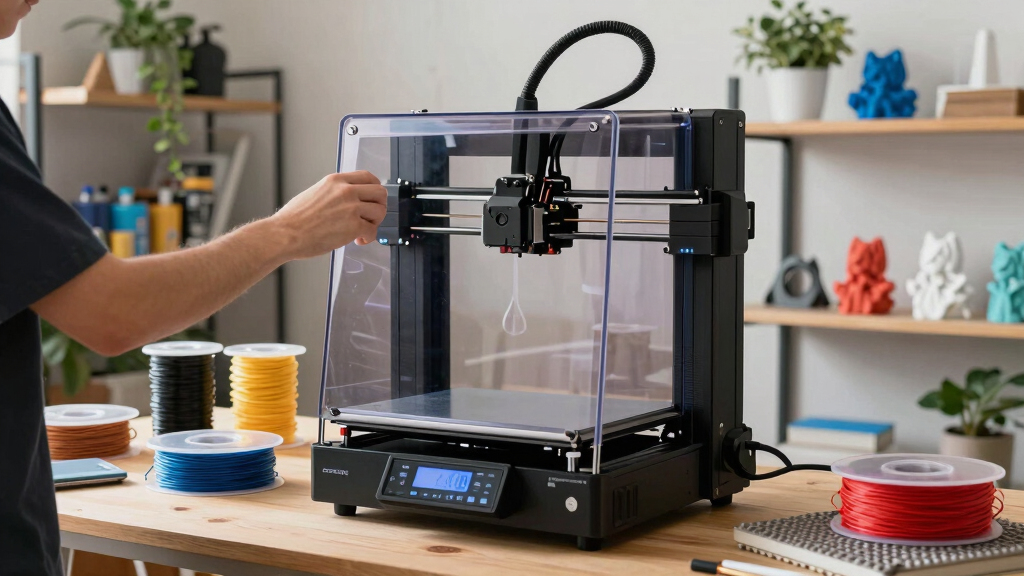
Finding the best enclosed 3D printer for a home studio involves balancing safety, print quality, and ease of use. The Creality K2 Pro Combo stands out for its high speed and dual AI cameras, ideal for serious hobbyists. The QIDI Q2 offers a versatile multi-material setup with a fully enclosed chamber, perfect for detailed projects. However, tradeoffs include higher costs and potential complexity for beginners. Keep reading for a detailed comparison that helps you match a printer to your specific needs and skill level.
Key Takeaways
- Top picks balance speed, print quality, and safety features tailored for home studios.
- Enclosed chambers significantly improve print reliability and reduce fumes, especially when working with high-temp materials.
- Higher price points generally offer better automation, faster speeds, and multi-material support, but may be overkill for casual users.
- Ease of setup and auto-calibration features are critical for beginners, while advanced users value versatility and speed.
- The best options for small spaces prioritize compact design without sacrificing core performance.


More Details on Our Top Picks
AOSEED 3D Printer for Kids, AI-Powered Fully Assembled 3D Printer with Up to 400mm/s Speed, Auto Leveling, 1500+ Models & 16+ Modules, Includes 8 PLA Filaments for Home and School Use, X-MAKER JOY AI+
This AI-powered printer stands out for making 3D printing accessible to children and families, thanks to voice commands, one-tap operation, and a fully enclosed design that prioritizes safety. Compared to the QIDI Q2, which is more geared toward advanced users, the AOSEED X-MAKER JOY AI+ simplifies the process so even young kids can create with minimal supervision. Its impressive speed peaks at 400 mm/s, allowing quick project completion, though this high speed could compromise print quality if not managed carefully. The extensive library of models and DIY modules encourages ongoing creativity, but the tradeoff is that it’s less suitable for high-precision prototyping or professional work. The built-in camera for real-time monitoring and automatic time-lapse videos makes sharing progress easy, yet the system’s simplicity limits detailed customization for experienced users. Overall, this makes the most sense for families or educators seeking a safe, fun, and straightforward introduction to 3D printing.
Pros:- User-friendly with voice control and one-tap operation
- Fully enclosed, child-safe design
- Fast printing speeds up to 400 mm/s for small projects
- Includes extensive model library and DIY modules
Cons:- Limited print resolution compared to professional-grade printers
- Speed may affect print quality for detailed designs
- Not suitable for complex multi-material or high-precision prototyping
Best for: Parents, teachers, and kids who want an easy, safe, and entertaining introduction to 3D printing without the need for technical expertise.
Not ideal for: Hobbyists or professionals requiring high-precision, multi-material prints or complex customization options that go beyond basic models.
- Maximum Speed:400 mm/s
- Build Volume:150 x 150 x 150 mm
- Supported Filaments:PLA
- Auto Leveling:Yes
- Connectivity:Wi-Fi
- Enclosure:Fully enclosed
Bottom line: This printer is ideal for families, schools, and young creators seeking a safe, simple, and engaging way to explore 3D printing without technical hurdles.
Creality K2 Pro Combo (A) 3D Printer with CFS, 600mm/s Speed, Dual AI Cameras
The Creality K2 Pro excels in high-speed, multi-material printing with a maximum speed of 600 mm/s and a generous 300×300×300 mm build volume, making it well-suited for busy makers and small-scale production. Unlike the QIDI Q2, which emphasizes precision and user-friendliness, the K2 Pro is designed for rapid output and multi-color capabilities with its CFS smart filament system supporting up to 16 colors. Its active chamber heating enhances material compatibility, especially with advanced filaments like ABS and ASA, but the setup can be complex and may require some technical know-how. The dual AI cameras provide superior monitoring and flow optimization, perfect for those who want real-time oversight without constant supervision. The primary tradeoff is the high cost, which might be prohibitive for casual hobbyists, and the large size demands a dedicated, ventilated space. Overall, this printer is best for experienced users seeking speed, volume, and multi-material versatility.
Pros:- High-speed printing up to 600 mm/s
- Large build volume (300×300×300 mm)
- Supports up to 16 colors with CFS system
- Dual AI cameras for monitoring and flow optimization
Cons:- High price point limits accessibility for hobbyists
- Complex setup and calibration process
- Large footprint requires substantial space
Best for: Small businesses, experienced hobbyists, or educational labs needing fast, multi-color, and large-volume printing capabilities.
Not ideal for: Beginners or those with limited space or budget, since setup complexity and cost are significant considerations.
- Build Volume:300×300×300 mm
- Max Speed:600 mm/s
- Supported Materials:PLA, ABS, ASA, PPA-CF
- Chamber Heating:Up to 60°C
- Cameras:Dual AI cameras
- Filament System:CFS
Bottom line: This printer is best suited for advanced users who prioritize speed, multi-material capability, and larger build sizes for production or complex projects.
FLASHFORGE AD5X Multi-Color 3D Printer with IFS, 600mm/s High Speed, 300°C High Temp Direct Extruder, Fully Auto Leveling, All Metal CoreXY,4-Color Printing for PLA-CF,PETG-CF, 220x220x220mm
The FLASHFORGE AD5X stands out for its exceptional speed—up to 600 mm/s—and multi-color capabilities, making it suitable for production environments and advanced hobbyists alike. Its IFS system simplifies multi-filament switching, and the auto-leveling feature reduces setup time, similar to the QIDI Q2 but with a focus on multi-color versatility. The all-metal CoreXY structure ensures stable high-speed operation, and the high-temp hotend (up to 300°C) supports advanced materials like PETG-CF and TPU. Compared to the QIDI Q2, which offers more beginner-friendly features, the AD5X is designed for demanding users who prioritize speed and multi-material use. However, its complexity can be daunting for newcomers, and the smaller build volume might limit larger projects. This makes it a great choice for professional prototyping or small batch manufacturing.
Pros:- Supports multi-color and multi-material printing
- High-speed performance up to 600 mm/s
- Auto leveling reduces setup time
- High-temp hotend for advanced materials
Cons:- Steep learning curve for beginners
- Limited build volume (220×220×220 mm)
- Higher price point for advanced features
Best for: Industrial designers, production-oriented hobbyists, or professionals needing rapid, multi-color, multi-material output in a compact form.
Not ideal for: Beginners or casual users who prefer simpler, plug-and-play solutions or larger build areas.
- Build Volume:220×220×220 mm
- Max Speed:600 mm/s
- Supported Materials:PLA, PETG, TPU, PPA-CF
- Hotend Temperature:up to 300°C
- Leveling System:Auto
- Filament Support:Multi-color, multi-material
Bottom line: Ideal for users with some experience seeking fast, versatile multi-material production in a compact, enclosed system.
QIDI Q2 3D Printer with Enclosed Heated Chamber, AI Camera, and Multi-Material Support
The QIDI Q2 offers a balanced mix of professional features and user-friendly design, including an enclosed chamber that minimizes warping, and an AI camera for remote monitoring. Its full-metal CoreXY frame and auto-leveling make high-speed, precise printing achievable, comparable to the QIDI Q2C but with a slightly smaller build volume (270×270×256 mm). The support for 16-color multi-material printing and advanced filaments like PPS-CF makes it suitable for prototypes, functional parts, and vibrant models. Its high-temperature hotend (up to 370°C) and sophisticated filtration system ensure high-quality results in challenging materials. While it’s more expensive than entry-level models, the Q2’s reliability and ease of operation appeal to both beginners stepping up and professionals needing consistent output. The tradeoff is that it’s a more complex setup than simpler printers, and space requirements are significant.
Pros:- Enclosed heated chamber reduces warping
- Supports 16-color multi-material printing
- High-speed up to 600mm/s
- AI camera for remote monitoring
Cons:- Higher price than basic models
- Setup complexity for new users
- Relatively large footprint
Best for: Professional makers, educators, and advanced hobbyists seeking a reliable, multi-material printer with high-speed and high-temperature capabilities.
Not ideal for: Complete beginners or those on a tight budget who need a straightforward, low-cost entry-level machine.
- Build Volume:270×270×256 mm
- Max Speed:600 mm/s
- Supported Materials:PLA, ABS, PETG, TPU, PA, PC, PPS-CF
- Heated Chamber:Up to 65°C
- Filtration:G3 pre-filter + HEPA + activated carbon
- Hotend Temp:370°C
Bottom line: This printer is best for experienced users demanding professional-quality, multi-material, high-speed prints with minimal manual intervention.
QIDI Q2C 3D Printer, Enclosed FDM with New Generation Leveling Sensor for Full Auto Leveling, 600mm/s High Speed, 270x270x256mm Build Volume, 370℃ Bimetal Hotend Unlock PPS-CF, from Beginner to Expert
The QIDI Q2C surpasses many expectations with its automatic leveling sensor, high-speed capability, and support for demanding materials like PPS-CF at up to 370°C. It offers a reliable, professional-grade experience with minimal manual calibration, similar to the QIDI Q2 but with added automation for quick setup. Its robust CoreXY structure and linear rails ensure stability at high speeds, making it suitable for complex, detailed prints. The support for up to 16 colors and multi-materials via the QIDI BOX software makes it versatile for prototypes or vibrant models, comparable to the FLASHFORGE AD5X but with a more user-friendly interface. The 270×270×256 mm build volume is adequate for most applications, but its high price and technical setup may deter casual hobbyists. Overall, this is an excellent choice for those seeking reliability, speed, and material versatility.
Pros:- Full auto leveling with advanced sensor
- High-speed up to 600mm/s
- Supports 16 colors and multi-materials
- Reliable, professional-grade construction
Cons:- Higher cost for complex features
- Requires some technical knowledge for setup
- Moderate build volume for larger projects
Best for: Professional designers, educators, and advanced hobbyists who need automated, high-speed, multi-material printing with professional results.
Not ideal for: Beginners or users with limited space and budget who prefer simple, manual-leveling machines.
- Build Volume:270×270×256 mm
- Max Speed:600 mm/s
- Supported Materials:PLA, ABS, PETG, TPU, PPS-CF
- Leveling:Full auto
- Hotend Temp:370°C
- Filament Support:Multi-color, multi-material
Bottom line: This printer is perfect for experienced users demanding fast, reliable, multi-material, professional-quality prints with minimal manual calibration.
FLASHFORGE AD5M Pro 3D Printer 600mm/s High Speed & Precision, Full-Auto Calibration with 0.4&0.6mm Nozzle Bundle, CoreXY Structure & Auxiliary Chamber Cooling, ≤50 dB Quite Printing Camera Printers
This printer stands out for its impressive combination of high-speed capabilities, automated features, and safety measures, making it ideal for home users who want reliable, fast results with minimal manual calibration. Compared with the FlashForge Adventurer 5M Pro, which emphasizes user convenience and connectivity, the AD5M Pro offers superior speed and multi-material support thanks to its direct drive extruder and CoreXY design. The built-in camera and remote management tools add a layer of control that benefits busy creators. However, this comes with the tradeoff of a slightly more complex setup and a higher price point. The dual filtration system and enclosed design make it safer and quieter for home studios, supporting prolonged use without disturbing others. The auto-leveling system simplifies bed calibration, although the multiple nozzle sizes and high-temp capabilities mean more maintenance and an initial learning curve. Overall, this pick is best for hobbyists and professionals who prioritize speed and quality without sacrificing safety and ease of use, but it may be overkill for absolute beginners or those with limited space.
Pros:- Exceptional high-speed printing up to 600mm/s, greatly reducing production time
- Fully automated auto-leveling and multi-material support streamline setup and expand creative possibilities
- Enclosed, quiet design with auxiliary chamber cooling enhances safety and reduces noise pollution
- Remote monitoring and management via Flash Maker app increase convenience
Cons:- Higher price point may be a barrier for casual hobbyists
- More complex setup and learning curve compared to simpler printers like the Adventurer 5M Pro
- Maintenance can be intensive due to multiple nozzle sizes and high-temp capabilities
Best for: Experienced hobbyists and small professional studios needing fast, multi-material prints with minimal calibration fuss
Not ideal for: Beginners or users with very limited space who prefer simple, plug-and-play solutions and are on a tight budget
- Build Volume:600 x 600 x 600 mm
- Nozzle Sizes:0.25mm, 0.4mm, 0.6mm, 0.8mm
- Max Extruder Temperature:280°C
- Quiet Mode:≤50 dB
- Connectivity:Wi-Fi, remote monitoring
- Filament Compatibility:TPU, ASA, PLA, ABS, PETG, PLA-CF, PETG-CF
Bottom line: Ideal for advanced users seeking a fast, multi-material, enclosed printer that balances speed, safety, and automation for home studios.
FLASHFORGE Adventurer 5M Pro 3D Printer with 1 Click Auto Printing System, 600mm/s High-Speed, Quick Detachable 280°C Nozzle, Core XY All-Metal Structure, Multi-Functional 220x220x220mm 3D Printer
This model excels in delivering rapid, reliable prints with its impressive 600mm/s speed and automatic bed leveling, making it well-suited for users who want quick results with minimal fuss. It outperforms the Prusa CORE One in speed and ease of assembly, thanks to its all-in-one design and smart management features like remote control and filament detection. The dual-sided PEI platform and easy-to-change nozzle support detailed work and diverse materials, including PLA, ABS, and PETG. Nonetheless, its high-speed capabilities can sometimes compromise detail precision, especially for intricate miniatures, and the all-metal frame, while durable, adds to the weight and setup complexity. The user-friendly interface and quick unboxing make this perfect for hobbyists and semi-professionals, but absolute beginners who prefer a more straightforward, pre-assembled device may find it slightly overwhelming. This printer is best suited for creators who prioritize speed, automation, and multi-material versatility, but it requires a space that can handle its robust build.
Pros:- Blazing fast print speeds up to 600mm/s reduce overall production time
- Automatic bed leveling and smart management via mobile app simplify setup and monitoring
- Supports multiple nozzle sizes and materials, enabling versatile use
- Dual circulation system maintains a cleaner, dust-free environment
Cons:- High speed can lead to less detailed prints on very fine models
- All-metal frame adds weight, making setup and repositioning more challenging
- Initial calibration and assembly may be slightly complex for new users
Best for: Home studio creators and hobbyists looking for rapid, high-quality prints with straightforward operation
Not ideal for: Absolute beginners or those with limited space who prefer simple, pre-assembled machines
- Build Volume:220 x 220 x 220 mm
- Max Extruder Temperature:280°C
- Speed:Up to 600mm/s
- Auto Bed Leveling:Yes, pressure sensing
- Connectivity:Mobile app, remote monitoring
- Materials Supported:PLA, ABS, PETG, ASA, TPU, PC
Bottom line: Best for home creators who value speed, automation, and multi-material support in a reliable, enclosed system.
Original Prusa CORE One 3D Printer Kit, Removable Print Sheets, Beginner-Friendly 3D Printer DYI Kit, Fun to Assemble, Automatic Calibration, Filament Sample Included, Print Size 9.8 x 8.6 x 10.6 in
This kit offers a rewarding assembly experience combined with solid reliability and high-quality output, making it perfect for newcomers who want to understand their machine inside out. Its enclosed chamber and active temperature control support a wide range of materials, similar to the FlashForge AD5X, but with a focus on educational value and customization. The all-steel frame and active calibration system ensure consistent results, even for less experienced users. However, the DIY aspect means assembly takes time and patience, which might deter those seeking immediate use. While the print volume is slightly smaller, at 250×220×270mm, it still accommodates most hobby projects. The included filament sample and lifetime support from Prusa add to the appeal, though the initial setup can be intimidating for absolute beginners, and it requires more maintenance than pre-assembled models. Overall, this is a great choice for learners eager to build knowledge and mastery of 3D printing in their home studio.
Pros:- Engaging DIY assembly enhances understanding and confidence
- Reliable active calibration and enclosed chamber support diverse filaments
- Includes filament sample and lifetime technical support
- Robust all-steel frame ensures durability and stability
Cons:- Assembly can be time-consuming and challenging for newcomers
- Requires more maintenance and troubleshooting compared to ready-to-use printers
- Smaller print volume may limit larger projects
Best for: Beginners and students interested in learning the mechanics of 3D printing through hands-on assembly and reliable performance
Not ideal for: Users who want a quick, pre-assembled solution or those with minimal patience for DIY projects
- Build Volume:250 x 220 x 270 mm
- Active Calibration:Yes
- Chamber Temperature:Up to 55°C
- Material Compatibility:PLA, PETG, ASA, PC, Nylon
- Frame:All-steel
- Assembly:DIY kit
Bottom line: Great for beginners who want a dependable, educational 3D printer that they can assemble and understand deeply, though it demands patience and some technical skill.
How We Picked
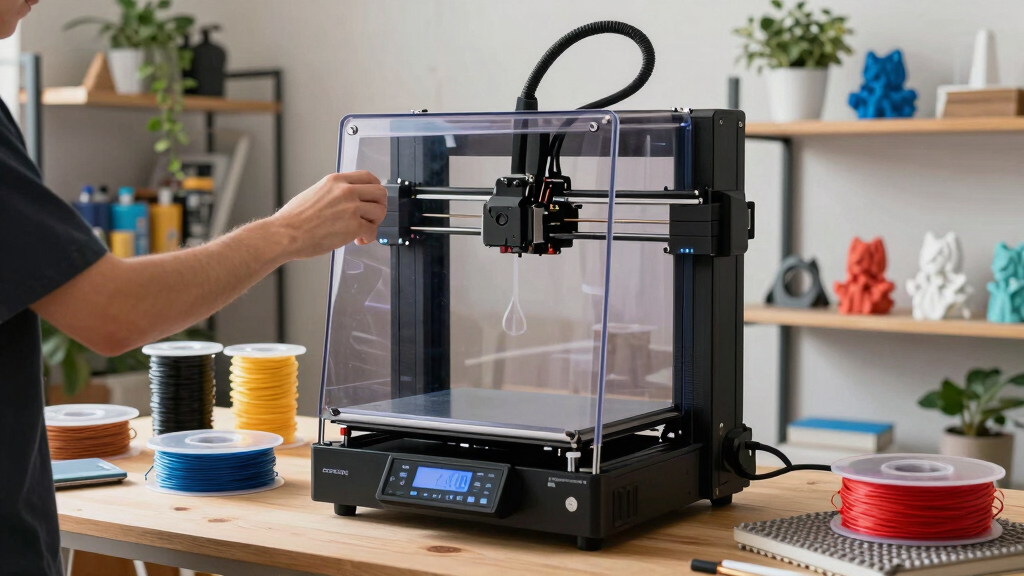
Our evaluation focused on a combination of performance, usability, build quality, safety features, and value. We prioritized printers with reliable auto-leveling, temperature control, and safety enclosures suitable for home environments. Speed and multi-material capabilities were also important, as these features enable broader creative possibilities without complicating operation. The ranking reflects a balance between affordability and advanced features, ensuring options for beginners through experienced users. We also considered user reviews and manufacturer reputation to gauge real-world reliability.
Factors to Consider When Choosing Best Enclosed 3d Printer For Home Studio
Choosing the best enclosed 3D printer for a home studio requires understanding key factors that influence performance, safety, and usability. The right choice depends on your budget, experience level, and specific project needs. Here are the main considerations to keep in mind before making a purchase.Print Volume and Space Constraints
Size matters when it comes to your projects. Smaller printers are more space-efficient but limit the size of your prints. Conversely, larger build volumes expand creative possibilities but often come with increased cost and complexity. Consider your typical project dimensions and available space to find a balanced fit.
Enclosure Quality and Safety
An enclosed chamber improves print consistency by maintaining stable temperatures and reducing drafts. It also enhances safety by containing fumes and hot components, making it essential for home studios. Look for sturdy construction, good ventilation options, and safety certifications to ensure peace of mind.
Ease of Use and Automation
Features like auto-leveling, touchscreen interfaces, and quick-change nozzles simplify operation, especially for beginners. Automations reduce setup time and minimize user errors, but often add to the price. Weigh the value of convenience features against your comfort level with manual adjustments.
Material Compatibility and Performance
The ability to print with multiple materials expands creative options, with some printers supporting high-temp filaments like ABS or PETG. Enclosed chambers facilitate printing with temperature-sensitive materials by reducing warping and layer separation. Be sure to check hotend and chamber temperature limits to match your project needs.
Cost and Long-Term Value
Higher upfront costs often translate into better build quality, faster speeds, and more features. However, budget options may suffice for simple models or beginners. Consider ongoing expenses like filament, maintenance, and potential upgrades to evaluate overall value for your specific use case.
Frequently Asked Questions
Is an enclosed 3D printer safer for home use?
Yes, enclosed 3D printers are generally safer for home environments because they contain hot components and fumes, reducing risk of burns and inhalation hazards. The enclosure also helps maintain stable temperatures, which improves print quality and reduces the chance of accidents caused by open hotends or moving parts. However, proper ventilation and safety practices remain essential, especially when printing with high-temp or filament fumes.
Can I print with high-temperature filaments in an enclosed 3D printer?
Most enclosed printers are designed to handle high-temperature filaments like ABS, PETG, or specialty composites because the enclosure maintains a stable, heated environment. This reduces warping and layer separation, leading to more reliable prints. Always verify the hotend and chamber temperature limits specified by the manufacturer to ensure compatibility and safety.
Are auto-leveling features worth the extra cost?
Auto-leveling simplifies setup and reduces calibration errors, which is especially valuable for beginners or busy users. It improves first-layer adhesion and overall print success rate. However, it adds to the initial purchase price and can sometimes require maintenance or updates. For experienced users comfortable with manual leveling, it may be a less critical feature.
How important is print speed for home studio use?
Print speed influences how quickly you can produce prototypes or models, which can be important if you’re working on tight schedules. Higher speeds, like 600mm/s, are appealing but may compromise detail or require more advanced hardware. For most home studios, a balance of speed and precision—around 100-200mm/s—is typically sufficient for quality results without excessive noise or complexity.
What maintenance should I expect from an enclosed 3D printer?
Regular maintenance involves cleaning the print bed, lubricating moving parts, replacing nozzles, and checking belts and wiring. Enclosed models tend to require less frequent cleaning of external components due to their design but may need more attention to temperature sensors and enclosures themselves. Choosing a model with accessible parts and good manufacturer support can simplify ongoing upkeep.
Conclusion
For casual hobbyists or those new to 3D printing, the QIDI Q2 offers a user-friendly experience with excellent auto-leveling and multi-material support. Professional creators or serious enthusiasts looking for high speed and multi-material versatility will find the FLASHFORGE AD5X or Creality K2 Pro compelling options, despite their higher costs. If space is limited or budget is tight, the Original Prusa CORE One Kit provides a reliable, DIY-friendly experience with good upgrade potential. Overall, your choice should align with your project scope, experience, and budget, ensuring you get the best fit for your home studio needs in 2026.